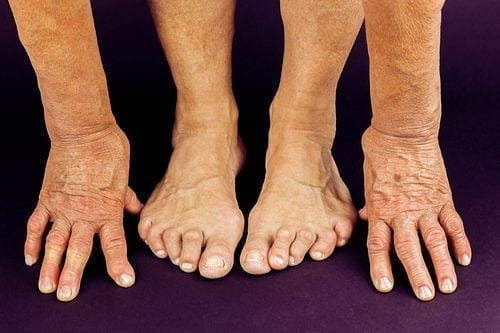
This article discusses how the Social Security Administration will evaluate your claim for disability benefits based on rheumatoid arthritis.
The Bishop Law Firm has represented Social Security Disability clients since 2009. We do not get paid unless we win. You can call us at 919-615-3095 for a free case review or start online now.

What is Rheumatoid Arthritis?
Rheumatoid arthritis is an autoimmune disorder that typically affects the small joints in your hands and feet.
Rheumatoid arthritis is more common in women and usually develops after age 40.
Autoimmune disorders occur when the body mistakenly attacks and destroys healthy cells and tissue (WebMD).
Unlike the wear-and-tear damage of osteoarthritis, rheumatoid arthritis affects the lining of your joints, causing painful swelling that can eventually lead to bone erosion and joint deformity.

Symptoms of Rheumatoid Arthritis
Our clients report swelling, joint pain and stiffness, nodules, and fatigue. Morning stiffness is a common symptom.
Rheumatoid arthritis usually begins in the small joints of the hands and feet and then progresses to larger joints (via Rheumatoid arthritis - MayoClinic.com).
In addition to the joints, the skin, eyes, lungs, heart, nerve tissue, and blood can all be affected.
If you are experiencing these symptoms, ask your doctor to run a rheumatoid factor or anti-cyclic citrullinated peptide antibody test.
However, some individuals with the above symptoms still test negative on blood work.
If a patient tests negative but has other symptoms, a diagnosis of Seronegative rheumatoid arthritis is given after ruling out other causes (Arthritis Foundation).
Rheumatologists diagnose and treat people with RA.
Treatment for Rheumatoid Arthritis
Treatment for Rheumatoid arthritis focuses on halting disease progression and reducing pain.
NSAIDS, DMARDS, and biologics are all options for treatment.
Steroids can also help temporarily to calm a flare, but for some people, steroids are needed long-term to control pain and inflammation (Understanding Rheumatoid Arthritis -- Treatment).
Unfortunately, long-term use of DMARDS and steroids comes with their own disabling side effects.
Infections, leukopenia, and anemia are all potential side effects (Cleveland Clinic).
Also read Disability Benefits for Arthritis.
Social Security Disability Benefits
Social Security offers two main types of disability benefits: Social Security Disability Insurance (SSDI) and Supplemental Security Income (SSI).
SSDI benefits are based on the credits from the work (FICA taxes) you have done in your life, while SSI benefits are a need-based program.
For more information, watch: Who can apply for SSDI/SSI?
After applying with the local SSA office or online, your case will be sent to Disability Determination Services (or your state's equivalent).
The Five-Step Sequential Evaluation
You must be found disabled under SSA's Five Step Sequential Evaluation before you are entitled to either benefit.
- Step 1 – Are You Working? The Social Security Administration defines work as “Substantial Gainful Activity” (SGA). SGA is roughly defined as work from earnings that average more than $1,690 per month (as of 2026). If you can perform substantial gainful activity, you generally will not qualify for disability benefits.
- Step 2 – Is Your Condition “Severe”? Severity is key when determining what qualifies as a disability. Severe is defined by the Social Security Administration as: your condition must interfere with basic work-related activities for your claim to be considered.
- Step 3 – Is Your Condition on the List of Disabling Conditions? The Listings are very hard to meet in most cases, and not always interpreted as a shared reading would suggest. If you meet a listing, you are gravely ill. The listings are here.
- Step 4 – Can You Do the Work You Did Previously? At Step 4, the SSA will establish your residual functional capacity (what you can still do despite your impairments). Then, the Social Security Administration will review your work history and determine whether it was sedentary, light, medium, or heavy. They will also evaluate the skill level: unskilled, semi-skilled, and skilled. For instance, an attorney would be sedentary skilled work. The Dictionary of Occupational Titles is here. SSA will compare your RFC to your past relevant work.
- Step 5 – Can You Do Any Other Type of Work? If the Social Security Administration determines that you can no longer perform your previous duties, they then assess whether you can still perform other tasks. This is where the “grids” come into play. The grids are the Medical-Vocational Guidelines. The grids are only for exertional impairments. The grids do not consider non-exertional impairments. If you are found to be capable of any other work, you will be found not disabled. Read The Grids and Your Social Security Disability Case.
Can you receive disability benefits for Rheumatoid Arthritis?

Yes, you can receive disability benefits for Rheumatoid Arthritis; however, the severity of your Rheumatoid Arthritis is key, not the name of the disease.
You will need medical evidence to demonstrate the severity of your Rheumatoid arthritis to SSA, which means you must seek ongoing treatment.
You must also follow all medical advice. Suffering from disabling symptoms when you are non-compliant with medical treatment will not help you win disability benefits.
The Social Security Administration can evaluate a disability claim in three ways: under the Listings, the Medical-Vocational Guidelines, or a combination of impairments.
The Listing for Rheumatoid Arthritis
SSA can evaluate disability claims based on RA under 14.09 Inflammatory Arthritis. 14.09 Parts A & B require loss of the ability to ambulate effectively OR perform fine and gross movements (manipulation) effectively, etc. In short, you have to have severe problems walking or using your hands.
14.09 Part D requires repeat manifestations (flare-ups) of inflammatory arthritis with two symptoms (severe fatigue, fever, malaise, or involuntary weight loss AND one of the following at the marked level:
- Limitations in activities of daily living.
- Limitations in maintaining social functioning
- Limitations in completing tasks in a timely manner due to deficiencies in concentration, persistence, and pace.
Listing 14.09, as with most listings, is challenging to meet. Most people are unable to work before they meet the requirements of this listing.
The Medical Vocational Guidelines (The Grids)
Even if you do not meet the above listing, you still may be found disabled under "The Grids" if you are 50 years or older and are limited to sedentary work.
For example, if we look at 201.01 on the page in Table No. 1, a person of advanced age (55+) who is limited to sedentary work with less than a high school education and unskilled work history is disabled under The Grids.
If you are under 50 years old, educated, or have a history of skilled work, The Grids will offer you less help.
A combination of your impairments
Unfortunately, Rheumatoid arthritis can increase the likelihood of developing other diseases.
Osteoporosis, carpal tunnel, peripheral neuropathy, heart disease, blood clots, COPD, Sjogren's Syndrome, and depression can co-occur with Rheumatoid arthritis.
You can visit our Social Security Disability Conditions page to search for your medical condition and learn how the SSA will evaluate it.
SSA must evaluate all of a claimant's impairments and symptoms together to determine if they are disabled.
A combination of symptoms and side effects from your medication may eliminate work for you.
Medications for RA alone can have disabling side effects that prevent employment.
Do you need an Experienced Disability Attorney?

Kimberly Bishop, of The Bishop Law Firm, is a North Carolina Board Certified Social Security Disability Law Specialist and has represented disability clients since 2009.
We represent clients with autoimmune disease at the initial and reconsideration levels, before SSA Administrative Law Judges, and beyond.
We offer free case reviews and do not get paid unless our client wins. Start your free case review online now.
If your Rheumatoid Arthritis is preventing you from working, apply for benefits as soon as possible and contact The Bishop Law Firm. We want to help!