If a medical condition has kept you from working, you may qualify for Social Security Disability benefits.
Attorney Kimberly Bishop of The Bishop Law Firm is a North Carolina Board Certified Specialist in Social Security Disability Law in Raleigh, NC, who has practiced disability law in North Carolina since 2009.
If you are looking for a Social Security Disability Lawyer in North Carolina, give us a call today for a free case review at 919-615-3095, or start your free case review online now.

Why clients choose The Bishop Law Firm for Social Security Disability cases:
- North Carolina Board Certified Specialist in Social Security Disability Law
- Representing disability claimants throughout North Carolina since 2009.
- Statewide disability representation
- Free case reviews
- No attorney fee unless you win and receive back pay
How Social Security Disability Law Is Different from Injury Claims
Social Security Disability law is governed by federal regulations and administered through the Social Security Administration (SSA).
Disability benefits such as SSDI and SSI are based on medical severity, functional limitations, and work history, not on whether another party caused an injury.
Unlike personal injury cases, Social Security Disability claims do not involve negligence, insurance companies, or civil lawsuits. They are handled through an administrative process with specific medical and vocational rules.
Disability law is also separate from Workers’ Compensation, which applies only to work-related injuries under state law. Each system has distinct eligibility requirements and legal procedures.
Read how disability benefits are affected by workers’ compensation and personal injury settlements.
Who should apply for Social Security Disability/SSI?
Individuals who are unable to work due to a health condition should apply for Social Security Disability Insurance (SSDI) or Supplemental Security Income (SSI).
In theory, anyone can apply for Social Security Disability or SSI.
However, the SSA may refuse to accept your application if you are still working, earn more than the SGA, have too many resources for SSI, or are not otherwise eligible for Social Security Disability Benefits.
Also watch: Who should apply for Social Security Disability?
When should I apply for Social Security Disability?
You should start the application process as soon as possible.
Unfortunately, I have had clients wait years after they stopped working to apply for benefits. I advise my clients to apply for benefits as soon as possible, because you never know what the future will bring.
If you can return to work, you can always withdraw your benefits claim with the Social Security Administration. In contrast, if you never apply and are unable to return to work, you may have just lost benefits you could have otherwise received.
Do I need a Social Security Disability Lawyer to apply?
No, you do not need Social Security Disability Lawyers to apply for or be awarded Social Security Disability Insurance benefits or Supplemental Security Income. However, having an SSDI lawyer on your case can improve your chances of winning by familiarizing you with the process and what the SSA is looking for to approve your Social Security Disability claim.
How can a Social Security Disability Attorney help my case?

A Social Security Disability Lawyer can help you navigate the disability process (see below for more details).
Appealing Denials
Denials and appeals are, unfortunately, components of most successful claims. Many people give up after receiving an initial denial. A disability lawyer who knows the appeals process can file an appeal and keep your case on track to the hearing level.
Gathering Medical Evidence
Our law firm obtains all medical evidence for our clients and delivers that evidence directly to the Social Security Administration. Clients do not have to run around trying to get their medical records.
Navigating Complex Regulations
The Social Security Administration has its own rules and regulations that it will follow when deciding a disability claim. An SSDI lawyer who knows the rules can review your medical evidence to present the correct legal argument to the decision-maker.
How much do Social Security Disability Attorney Fees cost?
The Social Security Administration sets attorney fees for disability cases. The SSA only pays attorney fees if the client wins their case and receives back pay. If you do not win your case, or if there is no back pay, no attorney fees are due.
Currently, SSA allows attorneys to charge up to 25% of the client’s back pay, up to a maximum of $9,200. For example, if the client attains $10,000 in back pay, the attorney will receive $2,500. If the client receives $100,000 in back pay, the attorney gets $9,200.
In addition to attorney fees, attorneys often ask clients to reimburse them for the costs of obtaining medical records, as the SSA does not cover these expenses. At my firm, these costs can range from $30 to $150-ish, depending on the volume of my client’s medical records.
Can I get disability if I have been diagnosed with ______?
What qualifies as a disability varies based on severity.
Severity is key, not the name of your disease. I have had clients with asthma so severe that they could barely breathe with the help of 24-hour oxygen use. I have also had clients with cancer whose medical records described them as capable of running a marathon.
You can visit our Social Security Disability Conditions page to search for your medical condition and learn how the SSA will evaluate it.
Substance Abuse can stop you from receiving disability benefits if it is found to be a material factor in your disability.
Also read: Do I have to go to a psychiatrist for Social Security Disability?
How do I apply for Social Security Disability Insurance (SSDI) or Supplemental Security Income (SSI)?
The first step to apply for disability benefits is to call your local Social Security Office to schedule an appointment to file, or apply online (start here). For a list of the required items for the application, please refer to this link.
There are two types of benefits that you may be eligible for: SSDI benefits, SSI, or both. Each type of benefit has different eligibility requirements, but you must be found disabled before you are entitled to either.
Types of Social Security Disability Benefits
Social Security Disability Insurance (SSDI)
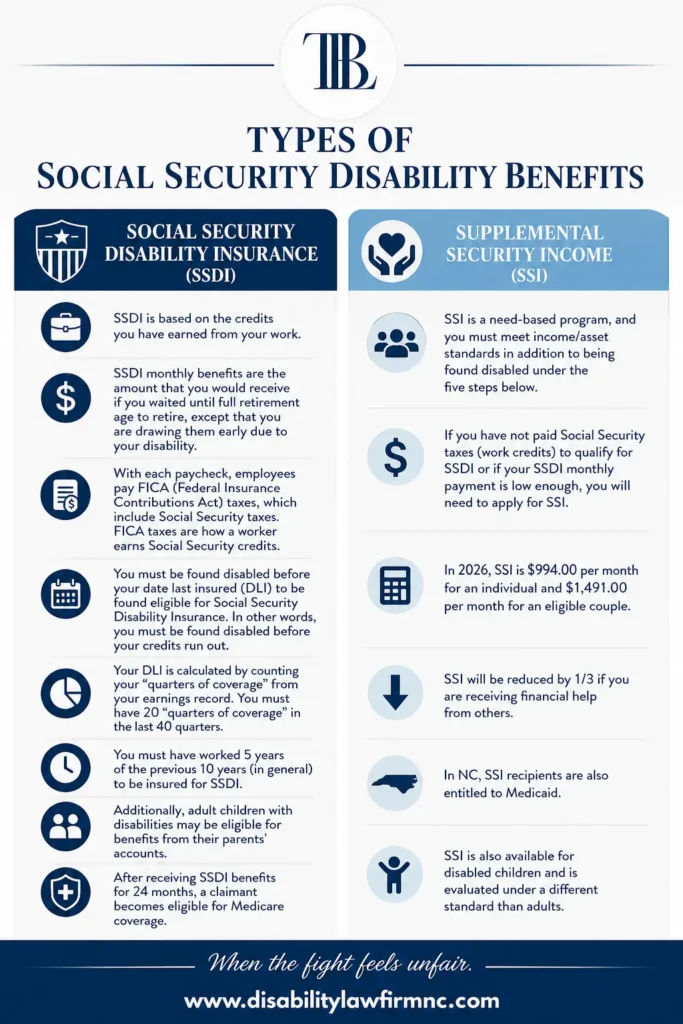
SSDI (Social Security Disability Insurance) is based on the credits you have earned from your work.
SSDI monthly benefits are the amount that you would receive if you waited until full retirement age to retire, except that you are drawing them early due to your disability.
With each paycheck, employees pay FICA (Federal Insurance Contributions Act) taxes, which include Social Security taxes. FICA taxes are how a worker earns Social Security credits.
You must be found disabled before your date last insured (DLI) to be found eligible for Social Security Disability Insurance. In other words, you must be found disabled before your credits run out.
Your DLI is calculated by counting your “quarters of coverage” from your earnings record. You must have 20 “quarters of coverage” in the last 40 quarters.
You must have worked 5 years of the previous 10 years (in general) to be insured for SSDI.
Additionally, adult children with disabilities may be eligible for benefits from their parents’ accounts.
After receiving SSDI benefits for 24 months, a claimant becomes eligible for Medicare coverage.
Also read Veterans Disability vs. Social Security Disability
Supplemental Security Income (SSI)
SSI (Supplemental Security Income) is a need-based program, and you must meet income/asset standards in addition to being found disabled under the five steps below.
If you have not paid Social Security taxes (work credits) to qualify for SSDI or if your SSDI monthly payment is low enough, you will need to apply for SSI.
In 2026, SSI is $994.00 per month for an individual and $1,491.00 per month for an eligible couple. SSI will be reduced by 1/3 if you are receiving financial help from others. In NC, SSI recipients are also entitled to Medicaid.
SSI is also available for disabled children and is evaluated under a different standard than adults.
Children must have a medically determinable physical or mental impairment or impairments (including emotional or learning problems) which result in marked and severe functional limitations, and the impairment(s) have lasted or can be expected to last for a continuous period of at least 12 months or be expected to result in death.
Child SSI terminates when the child turns 18. The claimant will then have to reapply and be evaluated under the adult sequential evaluation described below.
Five-Step Sequential Evaluation
At every step of the Disability Process below, SSA uses the Five-Step Sequential Evaluation to determine if you are disabled.
- Step 1 – Are You Working? The Social Security Administration defines work as “Substantial Gainful Activity” (SGA). SGA is roughly defined as work from earnings that average more than $1,690 per month (as of 2026). If you can perform substantial gainful activity, you generally will not qualify for disability benefits.
- Step 2 – Is Your Condition “Severe”? Severity is key when determining what qualifies as a disability. Severe is defined by the Social Security Administration as a condition that interferes with basic work-related activities for your claim to be considered.
- Step 3 – Is Your Condition on the List of Disabling Conditions? The Listings are very hard to meet in most cases, and not always interpreted as a shared reading would suggest. If you meet a listing, you are gravely ill. The listings are found here.
- Step 4 – Can You Do the Work You Did Previously? The Social Security Administration will review your work history to determine whether it was sedentary, light, medium, or heavy. They will also evaluate skill level as unskilled, semi-skilled, or skilled. For instance, an attorney would be doing sedentary, skilled work. The Dictionary of Occupational Titles is found here.
- Step 5 – Can You Do Any Other Type of Work? If the Social Security Administration determines that you can no longer perform your previous duties, they then assess whether you can still perform other tasks. This is where the “grids” come into play. The grids are the Medical-Vocational Guidelines. The grids are only for exertional impairments. The grids do not consider non-exertional impairments. If you are found to be capable of any other work, you will be found not disabled. Read The Grids and Your Social Security Disability Case.
Overview of the Social Security Disability Process
Initial
You are at the beginning of a process that could take over 2 years to complete. Step one is to call your local Social Security Office to schedule an appointment to file your initial claim, or you can start your application online here. For a list of the items you will need to apply, please refer to this link.
Apply for benefits as soon as possible; delay may cause you to lose benefits!
Disability Determination Services
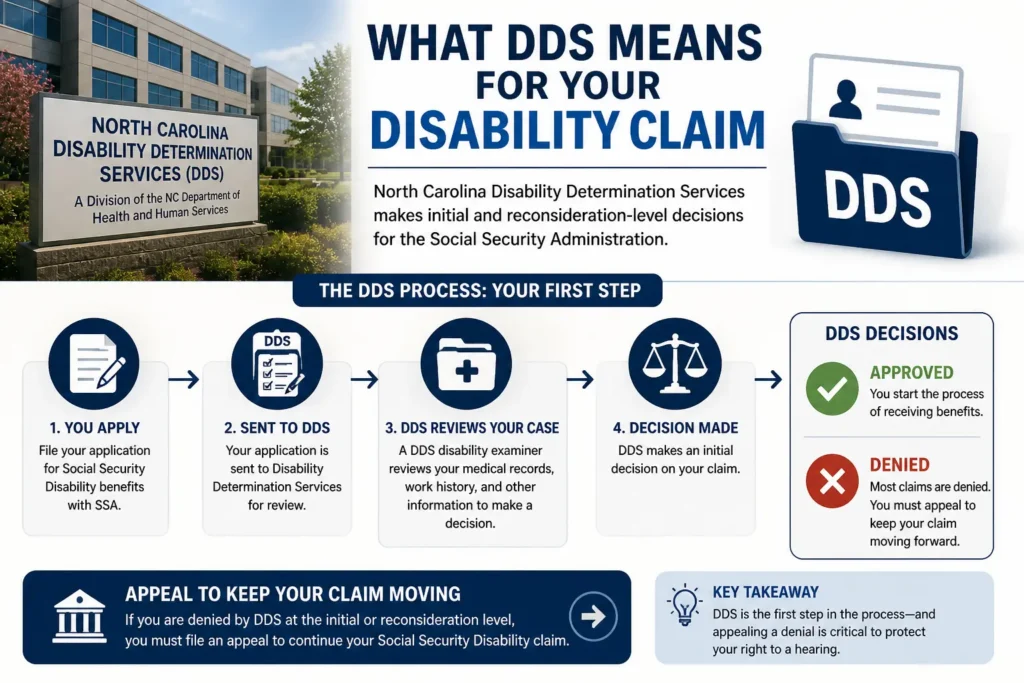
After you apply at the local Social Security Office or online, your case will be sent to DDS (Disability Determination Services) in Raleigh, NC.
Understanding how Disability Determination Services (DDS) actually handles disability claims in North Carolina can help you avoid the issues that lead to denials.
At DDS, an examiner will review your file, send you forms (e.g., work history forms and 3rd-party questionnaires for your family to complete), and order medical records for you.
The examiner may also refer you to a Social Security doctor for a physical or mental consultative examination.
The three most important things you can do for your case at the initial (and reconsideration) level are to return the forms to DDS as soon as possible, go to any consultative examinations they schedule for you, and get regular medical treatment from your doctors.
If you do not return the forms to DDS or go to the consultative examination, they can deny you on a technicality.
The DDS Examiner will then make a decision. If you are denied, you have 60 days from the date of the denial to request a reconsideration.
The Bishop Law Firm can assist you in requesting an appeal, communicating with DDS, and ensuring that your case progresses as efficiently as possible.
Reconsideration
You have received a denial on your initial application. The denial lists which medical records DDS considered and the Social Security Administration’s reason for determining you are not disabled.
The denial is upsetting, especially with being sick, having no health insurance, and having a low household income. You can file an appeal online or go to the local Social Security office to request an appeal or reconsideration.
When you request reconsideration, your case will be sent to DDS again.
A different examiner will review your case, send you additional forms to complete, and order any additional medical records you have. This examiner will then decide on your case. Statistically speaking, you have a far greater chance of being denied than you do of being approved.
If you receive a denial at the reconsideration level, you have 60 days from the date of the denial to request a hearing. A Social Security Disability Lawyer can help you request an appeal, communicate with DDS, and ensure your case moves as quickly as possible.
Hearing
You received your notice of reconsideration. This is your second denial. You are in shock at being denied twice by the Social Security Administration after they have requested so much information from you, your family, and your doctor.
You must request the next level of appeal, a hearing before an Administrative Law Judge (ALJ). It usually takes 4 -14 months to schedule your hearing, and this timeframe can be even longer if you live near Greensboro and Fayetteville, NC.
The Bishop Law Firm has experience with hearings, what ALJs expect, and what an ALJ needs to have to approve your disability case.
Representation is critical at the hearing.
Hiring a Raleigh Social Security Disability Lawyer can help at every stage, but it is critical at the hearing and beyond.
The Bishop Law Firm will review your file to make sure DDS did not make errors, that your medical records are complete, and that your doctor has been consulted for his/her medical opinion about your condition.
The hearing is your only opportunity to tell the SSA what is going on with you in your own words. The time should be used wisely to attain a favorable outcome.
Be prepared for your hearing.
Come to the hearing prepared to answer questions about work you have done in the last 5 years, your medication side effects (if any), what makes your symptoms better and/or worse, what methods you have tried to feel better (medicine, therapy, surgeries, i.e.), and what you think in your daily life that stops you from working.
Honesty is your friend, and over-exaggeration is your worst enemy in front of an SSA ALJ. Please understand that this ALJ has seen thousands of claimants and can spot issues like a hawk.
After the hearing, the ALJ usually makes a decision within 60-90 days.
If you lose at hearing, you can appeal to the Appeals Council (AC) OR open a new claim with the Social Security Administration if applicable. The Social Security Administration will not allow you to file an appeal and start a new claim.
You must choose the one that is right for your case. At the Bishop Law Firm, we have experience with these complex decisions and can advise you on the best course of action for your case.
Appeals Council
If you appeal the ALJ's denial, your request will be forwarded to the Appeals Council. The Appeals Council will review your case to see if the ALJ made a legal error.
The Appeals Council reviews the file and any arguments made by your Social Security Disability Lawyer. If the Appeals Council determines that a legal error was made, it will send your case back to the hearing office for another hearing.
The Appeals Council does not review your case to ensure the ALJ made the right decision. They only look for legal errors made by the ALJ.
The Appeals Council is slow and unresponsive. It may take 18 months for the Appeals Council to rule on your request for appeal. The Appeals Council can remand your case to an ALJ or approve it. Approvals are rare, but they do happen.
If the Appeals Council denies your appeal, you can file a case in District Court or submit a new application.
Federal District Court
If the Appeals Council denies review, you have three choices. You can file a claim in Federal Court, or you can start over again with an initial application to the local Social Security Office (or online as discussed above), or do both.
Federal Court (District Court) cases do not involve hearings or any meetings that you have to attend.
The government attorney assigned to your case will file a brief on behalf of the Social Security Administration. Social Security Appeal Lawyers will file a brief on your behalf, arguing why you should be found disabled under Social Security Disability Law.
The Federal Court judge will make a decision based solely on the briefs and records.
If the Federal Court judge agrees with you, he/she can approve your case or send your case back to the hearing office with instructions on how the ALJ can correct his/her error(s) of law.
Approvals at the DC level are rare, and remand is the usual remedy.
Final Thoughts
Applying for Social Security Disability and Supplemental Security Income can be challenging, but you have to stay determined.
For my clients going through this process, Social Security Disability is their last resort. A Social Security Disability Lawyer can improve your chances of winning your case by knowing what the SSA needs to find you disabled.
If you are unable to work because of your health, you do not have to face the fight alone. Whether you are filing your initial claim or appealing a denial, The Bishop Law Firm represents disability claimants throughout North Carolina:
- Raleigh
- Durham,
- Fayetteville
- Cary
- Rocky Mount
- Wilson
- Smithfield
- Louisburg
- Chapel Hill
- Roanoke Rapids,
- Winston- Salem
- Garner
- Greensboro
- Greenville
- and all of North Carolina