
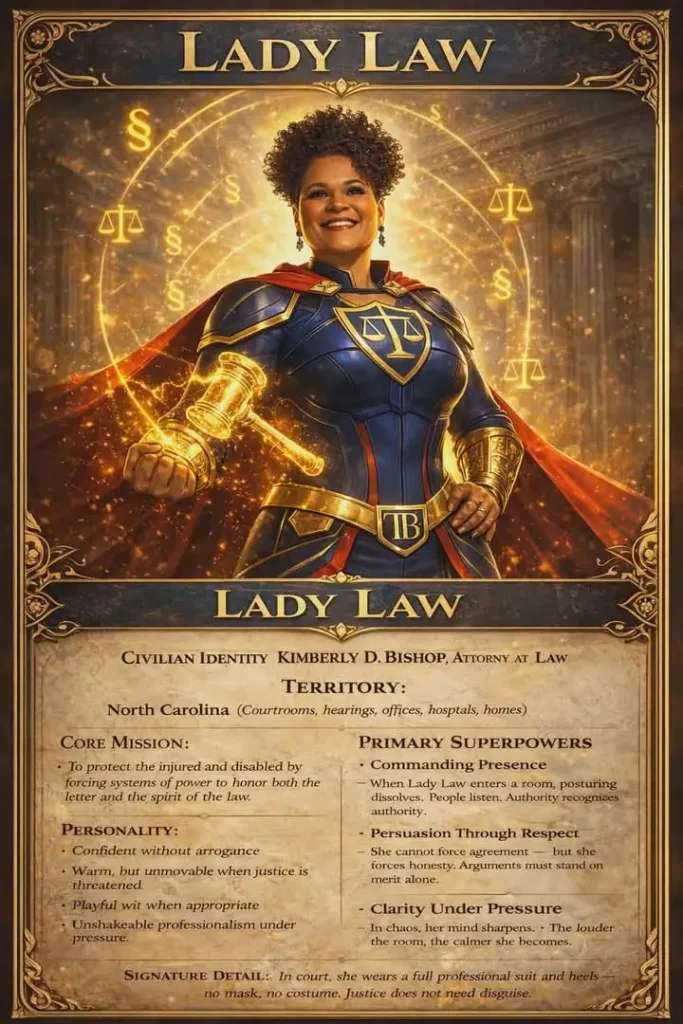
Who is Lady Law?
When the fight feels unfair, Lady Law steps in—steady, prepared, and relentless in making North Carolina’s legal system answer to the people it was meant to serve.
Civilian Identity:
Kimberly D. Bishop, Attorney at Law
Lady Law is the professional persona of attorney Kimberly D. Bishop, used to explain how real legal advocacy works for injured and disabled North Carolinians.
Territory:
North Carolina (Courtrooms, hearings, offices, hospitals, and homes)
Core Mission:
To protect the injured and disabled by holding systems of power accountable to the letter and the spirit of the law.
Personality:
- Confident without arrogance;
- Warm but unmovable when justice is threatened;
- Playful wit when appropriate;
- Unshakable professionalism under pressure.
Primary Superpowers:
Lady Law’s powers were not given—they were earned. Years spent fighting insurance companies, federal bureaucracies, and systems designed to deny and delay hardened her resolve and sharpened her instincts.
These are not superhuman abilities, but skills developed through years of real courtroom advocacy, legal training, and persistence.
Commanding Presence:
When Lady Law enters a room, posturing dissolves. People listen. Authority recognizes authority.
Persuasion Through Respect:
She cannot force agreement, but she forces honesty. Arguments must stand on merit alone.
Clarity Under Pressure:
In chaos, her mind sharpens. The louder the room, the calmer she becomes.
Signature Detail:
In court, she wears a full professional suit and heels - no mask, no costume. Justice does not need a disguise.
Lady Law's Weapons
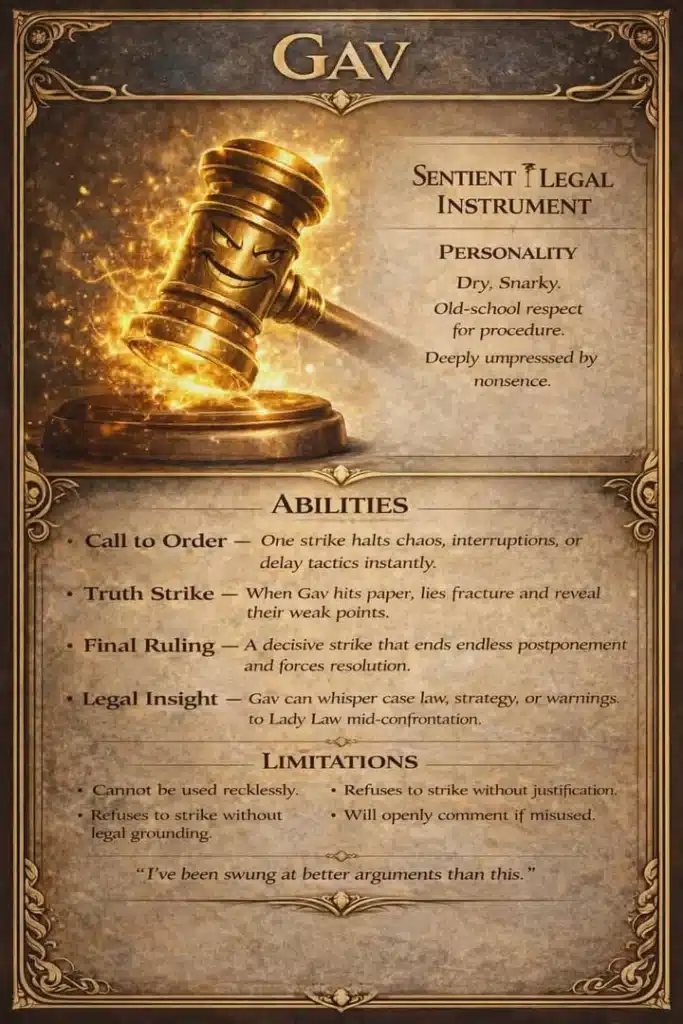
GAV
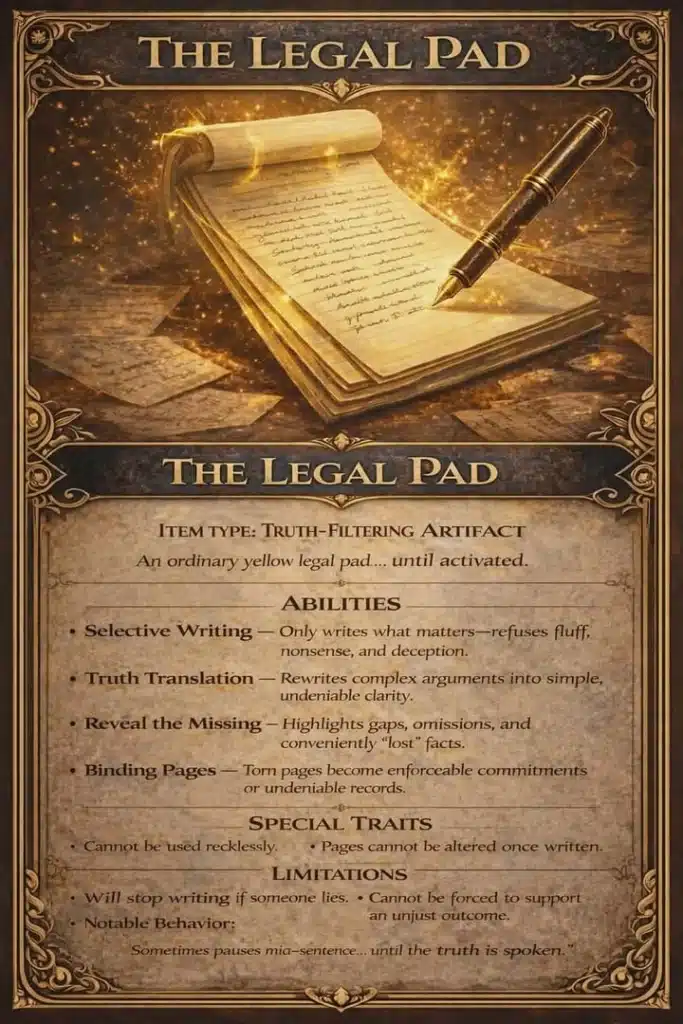
The Legal Pad
Lady Law's Enemies
The Denial Baron

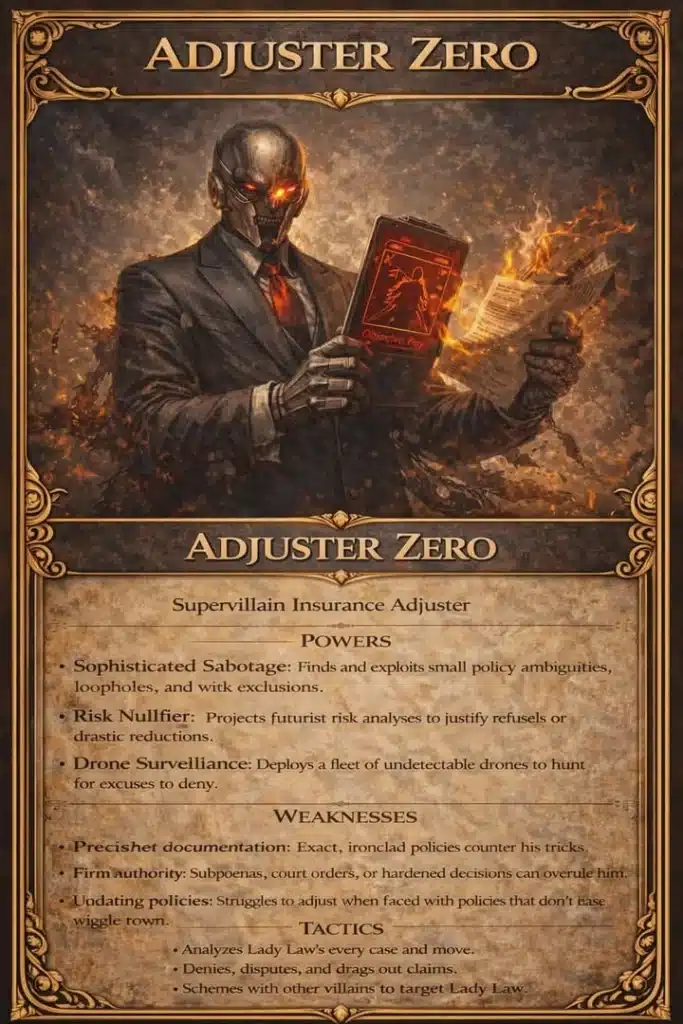
Adjuster Zero
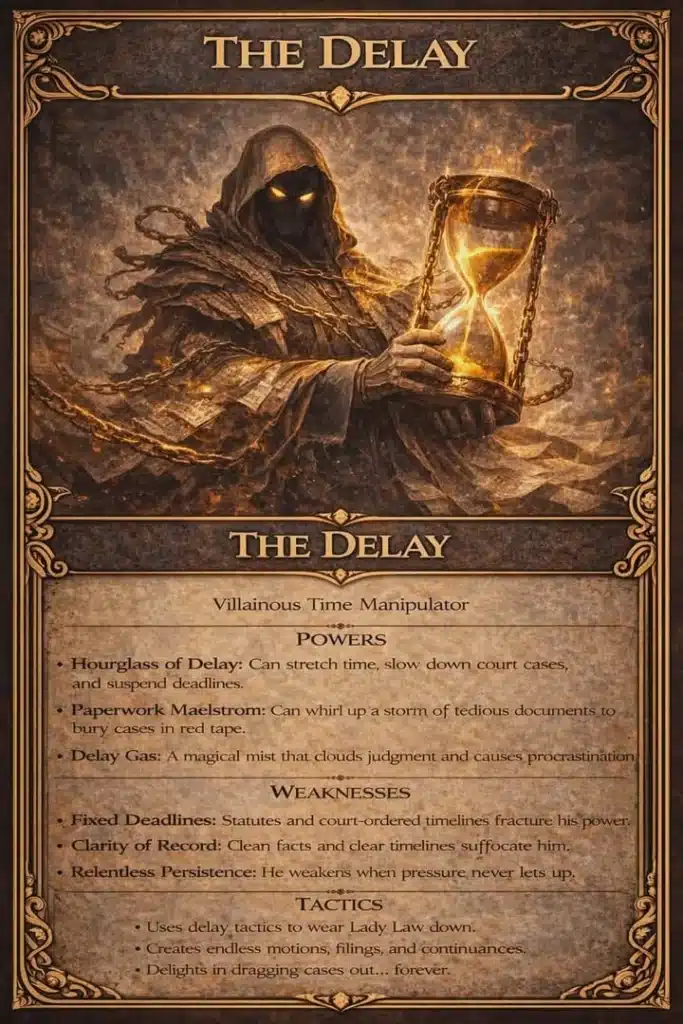
The Delay
The Lady Law Chronicles
Each chapter represents a real-world fight that injured and disabled people face every day.
Chapter One: When Justice Walks Through The Door
The courtroom was already leaning toward “no.”
Not loudly. Not officially.
Just… inevitably.
The kind of no that settles into the air before anyone speaks. The kind that lives in folded arms, tired eyes, and the subtle impatience of people who have already decided how this would end.
A woman sat at the defense table clutching a folder too thin to protect her. Her shoulders were drawn tight, as if she were trying to disappear into her chair. Across the room, paperwork was stacked high—neat, confident, unbothered. The system had arrived early and made itself comfortable.
The clerk cleared her throat.
The judge glanced at the clock.
And then—
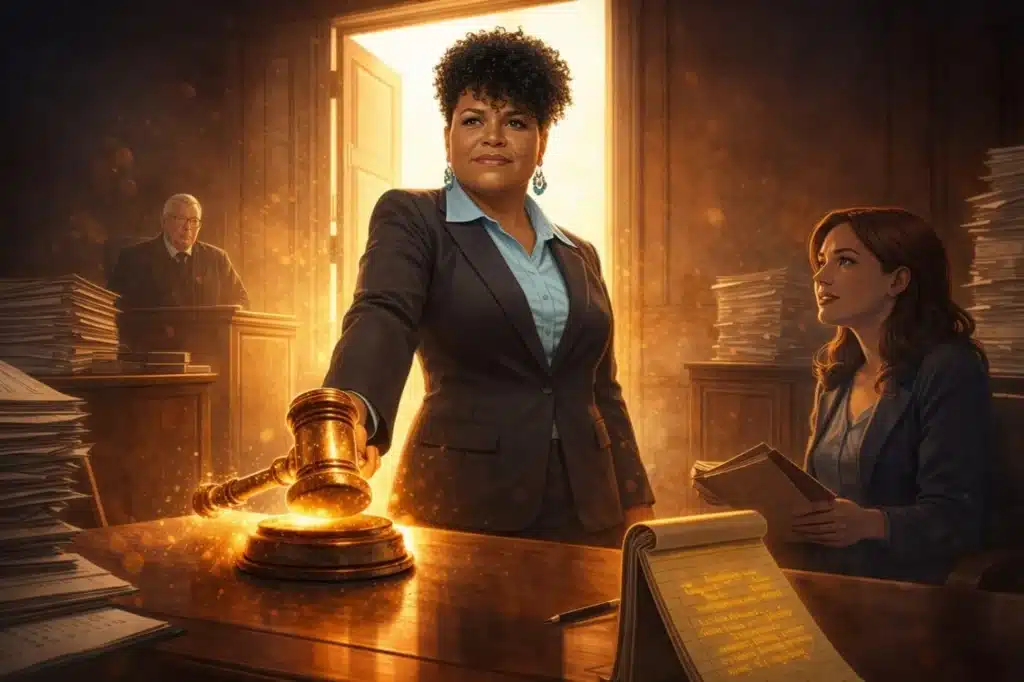
The doors opened.
They didn’t slam.
They didn’t creak.
They simply opened.
But the air changed.
Not dramatically. Not magically.
Just enough.
Enough that the murmurs stopped. Enough that a man midway through a sigh straightened without knowing why. Enough that the weight in the room shifted—like a scale adjusting itself before anyone touched it.
She stood framed in the doorway.
Lady Law.
She wore a tailored suit and heels, courtroom-appropriate and unmistakably professional. No mask. No cape fluttering behind her. Her hair was natural and powerful, her posture steady, her expression calm—but there was nothing ordinary about the way she entered a room.
She didn’t rush.
She didn’t hesitate.
She walked forward as if the floor had been waiting for her.
At her side, resting comfortably in her hand, was a gavel.
It glowed faintly gold.
Oh good, the gavel muttered under its breath. Another room full of bad arguments.
Lady Law didn’t respond. She never did—not out loud. But her fingers tightened just slightly around the handle, and the gavel hummed in recognition.
When she reached the table, the woman with the thin folder looked up. Hope flickered—small, cautious, but real.
Lady Law met her eyes and gave a single nod.
I’m here.
The judge cleared his throat again. “Counsel,” he said, adjusting his glasses, “we were just about to proceed.”
“Yes,” Lady Law replied, her voice warm and steady. “I know.”
She placed the gavel gently on the table. The gold glow faded, but the presence remained.
Across the room, someone shifted uncomfortably.
Lady Law looked up—not sharply, not accusingly—but directly. Her gaze didn’t challenge. It invited. It made space for truth to stand up straight.
When she spoke again, the room leaned in without realizing it.
“Before we begin,” she said, “there are a few things we need to clarify.”
The gavel vibrated once.
Understatement of the year.
Lady Law continued. “This case has been waiting a long time. Long enough for confusion to settle in. Long enough for paperwork to start speaking louder than people.”
She turned slightly, angling her body so the judge, the clerk, the opposing counsel—and most importantly, her client—were all included in the circle of her presence.
“But today,” she said, “we’re going to put things back where they belong.”
A pause.
Not an empty pause. A deliberate one.
The judge nodded slowly. “Very well,” he said. “You may proceed.”
Lady Law smiled—not triumphantly, not smugly—but with quiet confidence.
“Thank you.”
She reached into her briefcase and withdrew a legal pad. It looked ordinary. Yellow. Lined. Slightly worn at the edges.
The moment it touched the table, the pad stiffened.
Please, it whispered irritably, let this be a truth day.
Lady Law flipped it open.
The pen hovered.
Across the room, a stack of documents rustled, as if uneasy.
She began to speak—not quickly, not forcefully—but clearly. Each word landed exactly where it needed to. Timelines aligned. Facts straightened themselves. What had once seemed tangled began to breathe.
The legal pad started to write.
Slowly at first.
Then faster.
The woman at the table felt something unfamiliar press against her ribs.
Relief.
The opposing counsel opened his mouth.
The gavel cleared its throat.
I wouldn’t, it warned.
He closed it again.
Lady Law didn’t notice—or pretended not to. She was already moving forward, laying out the record, piece by piece. Not tearing anything down. Not accusing. Just revealing.
The courtroom listened.
By the time she finished, the room was no longer leaning toward “no.”
It was standing, balanced, waiting.
The judge sat back, thoughtful. “Ms. Bishop,” he said at last, “thank you.”
Lady Law inclined her head. “Of course.”
As the hearing adjourned and the room began to empty, the woman at the table looked up again—this time with tears in her eyes.
“I thought…” she began, then stopped, unsure how to finish.
Lady Law gathered her things. “I know,” she said gently. “A lot of people do.”
The gavel hummed approvingly.
Humans, it muttered. Always surprised when justice shows up.
Lady Law picked it up and slid it into her bag.
As she walked toward the doors, the golden glow flared briefly around her—not enough for anyone to point, not enough to disrupt the world—but enough to remind the Covenant of Justice that she was still at work.
She paused at the threshold and glanced back at the room.
Not with anger.
Not with pride.
With resolve.
Because this was only one case. One room. One moment.
And there were many more doors waiting to open.
Chapter Two: Power Without A Cape
Lady Law did not leave the courthouse when the hearing ended.
She moved through it.
Down hallways where voices softened as she passed. Past doors that had been closed for too long. Through spaces where decisions were made quietly, without witnesses, without accountability.
She walked as if the building itself recognized her.
The golden glow that had flickered around her moments earlier faded, but the weight of her presence remained. This was the part most people never saw—the work after the moment, the heroics without an audience.
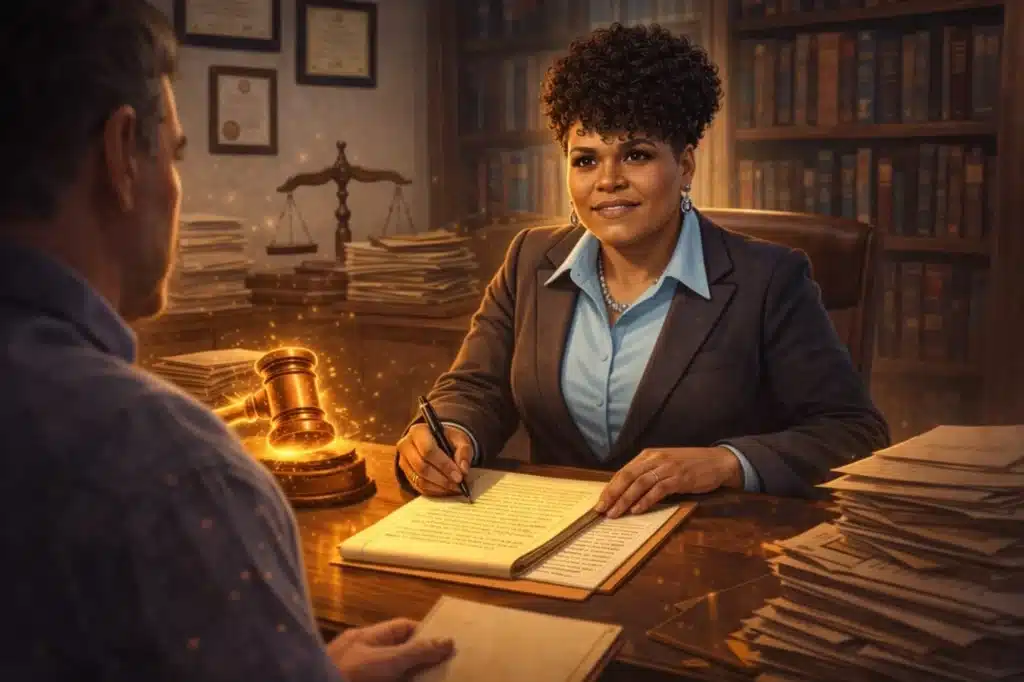
At her office, she set her briefcase on the desk and loosened her jacket. The room was warm with afternoon light, law books lining the shelves like watchful sentinels. Framed certificates rested on the wall, silent proof of years spent earning every ounce of authority she carried.
Lady Law exhaled.
The gavel stirred.
I give that argument a three out of ten, Gav muttered. Points deducted for confidence unsupported by reality.
She smiled faintly. “You’re generous.”
I’m charitable, Gav replied. It’s a character flaw.
She placed him carefully on the corner of her desk, where he promptly leaned against a stack of files as if settling in for commentary. Across from him, the Legal Pad lay closed, quiet for now. It preferred rest between battles.
Lady Law flipped open her calendar.
Names. Dates. Deadlines.
This was where her power sharpened.
She reviewed a case that had been delayed three times already. Another client who had been told to wait. Another quiet attempt to turn time into surrender.
“No,” she said softly.
The word carried no heat, no anger—but it was firm. Final.
She reached for the Legal Pad.
The pad stiffened, alert.
Please tell me this one isn’t allergic to facts, it whispered.
“We’ll find out,” Lady Law said.
She began organizing the record—not dramatically, not forcefully. She laid out timelines the way others laid out battle plans. Each document found its place. Each contradiction stood exposed by nothing more than proximity to truth.
As she worked, her phone buzzed.
“Ms. Bishop?” her assistant’s voice came through, tense. “We have a client who just came in. He says he was told there was no point in filing. That the system would never—”
“I’ll see him,” Lady Law said immediately.
She stood, smoothing her jacket, heels clicking once against the floor.
The Covenant stirred—not glowing, not announcing itself—but present. Watching.
When she entered the conference room, the man inside stood awkwardly, clutching a folder thick with fear and uncertainty. His shoulders were hunched, his eyes tired.
He looked up—and paused.
Something shifted.
Lady Law felt it, the way she always did. The moment where despair hesitated. Where hope tested the air.
“Please,” she said, gesturing to the chair across from her. “Sit.”
He did.
She listened first. Always.
As he spoke, Gav leaned closer.
I already don’t like how this starts, he murmured.
Lady Law nodded, absorbing every word. When the man finished, she didn’t rush to reassure him. She didn’t promise victory.
She promised honesty.
“Here’s what we can do,” she said calmly. “Here’s what matters. And here’s what they’re hoping you don’t understand.”
The Legal Pad slid forward on its own.
Oh good, it muttered. A misunderstanding in need of correction.
Lady Law began to write.
Not fast. Not slow.
Purposefully.
As she spoke, the man straightened. His grip on the folder loosened. The weight he carried didn’t disappear—but it redistributed. Shared now. Managed.
“This won’t be quick,” she said. “And it won’t be easy. But it will be done right.”
He swallowed. “You really think we have a chance?”
Lady Law met his eyes.
“I don’t take cases I don’t believe in,” she said. “And I don’t stop just because someone hopes I will.”
Gav hummed approvingly.
She means that.
When the meeting ended, the man left lighter than he arrived—not because the fight was over, but because he was no longer alone in it.
Lady Law returned to her desk and sat, the room quiet once more.
No cape.
No glow.
No audience.
Yet the Covenant pulsed steadily, satisfied.
Because this—this preparation, this clarity, this refusal to let the system quietly win—was the foundation of everything that came next.
She glanced at Gav.
“Ready?” she asked.
The gavel smirked.
Always. Bad arguments don’t defeat themselves.
Lady Law smiled and turned back to her work.
Justice didn’t need spectacle.
It needed persistence.
And she had plenty of that.
Chapter Three: Order
Chaos never announced itself.
It crept in quietly—through overlapping voices, rushed explanations, and the subtle confidence of people who believed no one would stop them.
The hearing room buzzed with impatience. Papers shuffled. Someone sighed too loudly. A voice near the back muttered, “This again?”
Lady Law stood calmly at the table, hands folded, eyes forward.
The Covenant of Justice stirred.
Not brightly.
Not loudly.
But it noticed.
Across from her, opposing counsel spoke quickly—too quickly—words tumbling over one another in a practiced attempt to overwhelm rather than clarify.
“…as previously stated, Your Honor, the record is incomplete, and therefore any further consideration would be premature—”
The gavel vibrated.
Lady Law rested her palm lightly against it.
Oh no, Gav whispered. We are not doing this today.
She waited. She always did. Let the argument hang long enough to reveal its own weakness.
The judge rubbed his temple. “Counsel,” he said, “let’s try to keep this—”
The opposing voice continued.
Gav inhaled.
That was the problem.
No one else heard it. No one else felt it. But Lady Law did.
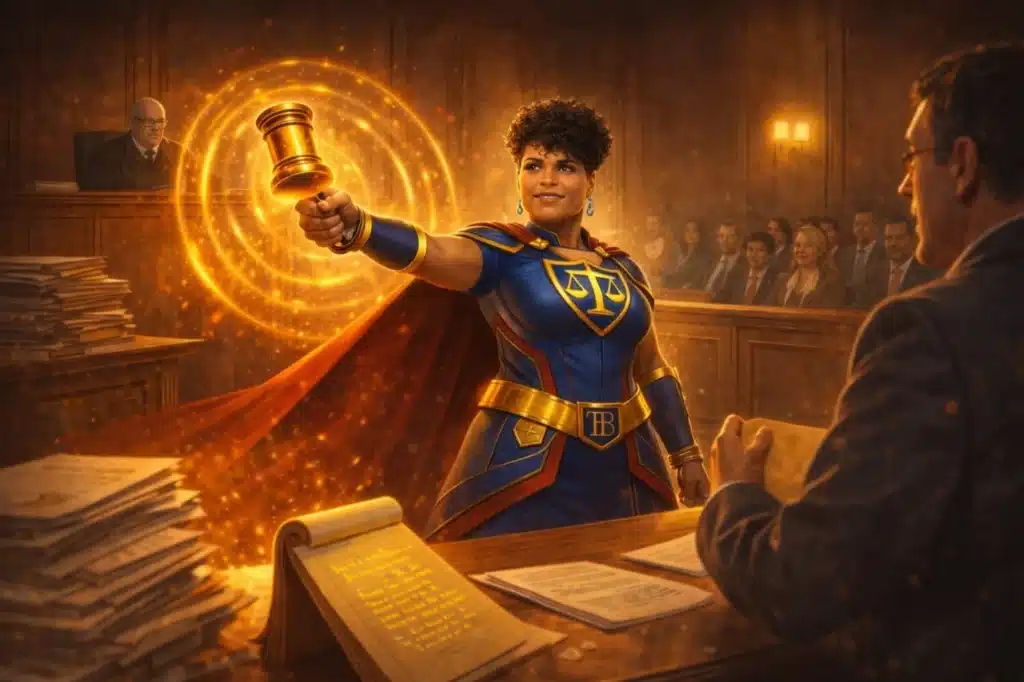
She lifted the gavel.
Not dramatically. Not angrily.
Just enough.
ORDER.
The word didn’t echo.
It settled.
Sound snapped into place. Papers stilled. Even the air seemed to stop mid-motion, as if the room itself had decided to listen.
Golden light flared—not blinding, not explosive—but unmistakable. A thin ring of it spread outward from the gavel, touching the walls, the floor, the benches.
The talking stopped.
The judge blinked once. Then sat up straighter.
Opposing counsel froze mid-sentence, mouth open, eyes wide.
Gav glowed.
Thank you, he said pleasantly. Now that we have everyone’s attention…
Lady Law set the gavel down gently.
“Let’s proceed properly,” she said.
Her voice was calm. Warm. Unyielding.
She turned slightly, angling herself toward the judge. “The record is not incomplete. It’s disorganized. There’s a difference.”
The Legal Pad slid forward on the table and flipped itself open.
Finally, it muttered. Someone who respects chronology.
Lady Law spoke again, and this time, each sentence landed with precision. Dates aligned. Statements corrected themselves simply by being placed next to the truth. The confusion that had once filled the room began to evaporate.
Opposing counsel tried to interrupt.
Gav leaned forward.
I wouldn’t, he advised.
The interruption died in the throat it had risen from.
Lady Law continued.
“This delay,” she said, gesturing lightly toward the paperwork, “isn’t procedural. It’s convenient. And convenience is not a legal standard.”
The judge nodded slowly.
Across the room, the system shifted uneasily.
Gav hummed. She’s being nice today.
Lady Law closed the Legal Pad and looked directly at the opposing counsel—not accusingly, not triumphantly—but expectantly.
“Do you have anything further?” she asked.
Silence.
The judge cleared his throat. “I believe we’re ready to move forward.”
A ripple moved through the room—not relief, not celebration—but something rarer.
Respect.
As the hearing adjourned, Gav dimmed slightly, satisfied.
Another mess cleaned up, he said. You’d think they’d learn.
Lady Law gathered her things.
“They count on people being tired,” she replied. “Being confused. Being quiet.”
Gav snorted. Unfortunate strategy.
As they walked out of the room together, the Covenant pulsed once, approving.
Order had been restored—not through force, not through volume—but through clarity and resolve.
And somewhere deep within the system, something old and stubborn took note.
Lady Law had arrived.
And she was not interested in letting chaos run the show.
Chapter Four: Truth Writes Back
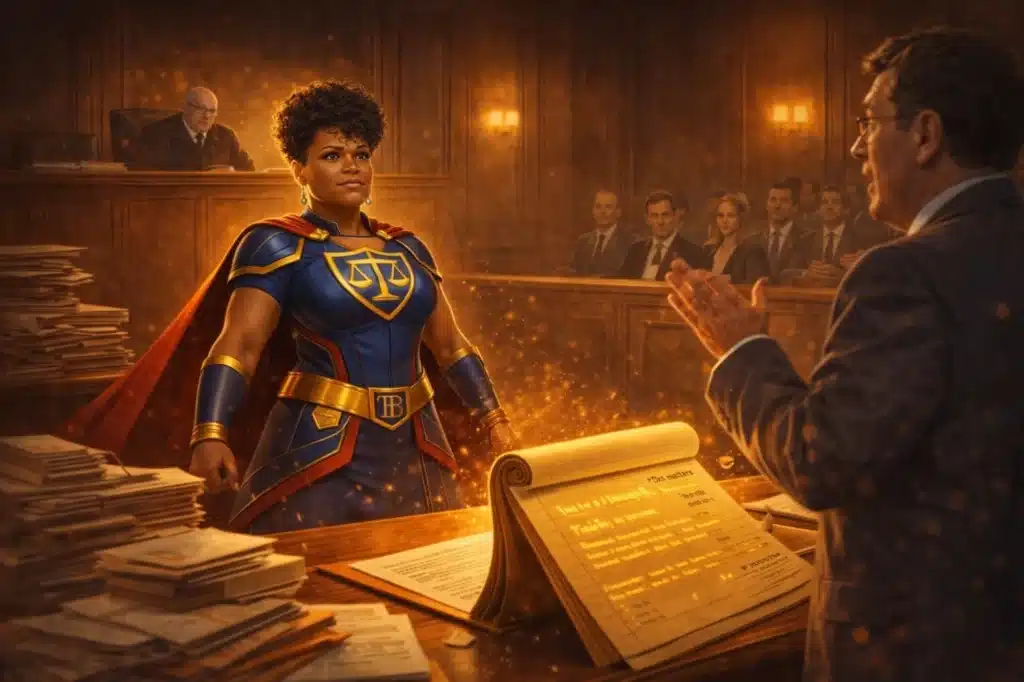
The Legal Pad did not like being ignored.
It tolerated it, of course. It was patient by design. But patience did not mean approval.
Lady Law sat at her desk long after the building had quieted, the glow of her desk lamp carving a circle of focus in the dim office. Outside the window, the city moved on—unaware, indifferent. Inside, truth waited to be organized.
Stacks of paper surrounded her. Medical reports. Denial letters. Timelines that contradicted themselves the moment they were placed side by side.
The kind of mess that made people give up.
Lady Law adjusted her chair and rolled her shoulders once.
“Alright,” she said calmly. “Let’s see what they’re hiding.”
The Legal Pad slid forward an inch.
Finally, it muttered. I was beginning to think we were just decorative.
She flipped it open.
The pen hovered.
Nothing happened.
Lady Law frowned slightly. “That bad?”
The pad remained blank.
Worse, it replied. Disorganized. Emotionally manipulative. Chronologically offensive.
Gav, resting nearby, snorted. You always say that.
Because it’s always true.
Lady Law smiled faintly and began speaking—not to the pad, but to the facts.
She didn’t rush. She never rushed this part. She narrated timelines out loud, letting the truth hear itself spoken. Dates. Diagnoses. Appeals filed. Appeals ignored.
The pen twitched.
Then—finally—the pad began to write.
Not what was on the documents.
What should have been.
Sentences rearranged themselves. Paragraphs tightened. Marginal notes appeared without invitation.
This matters, the pad wrote firmly.
This does not.
Lady Law leaned in, eyes sharp.
There it was.
A missing report. Not denied—lost. A deadline that had quietly shifted without notice. A decision justified by a regulation that didn’t apply.
Her jaw set.
“That’s convenient,” she said softly.
Convenience is not a defense, the pad replied, underlining the sentence itself.
Gav glowed faintly. Oh, I like where this is going.
Lady Law worked through the night, the Legal Pad guiding the narrative back into alignment. Where chaos had been used as camouflage, clarity now burned like a spotlight.
By morning, the file was no longer heavy.
It was sharp.
She gathered the papers, sliding the Legal Pad into her briefcase last.
Don’t fold me, it warned.
“I wouldn’t dare.”
The next hearing began with confidence on the other side of the room.
Too much confidence.
Opposing counsel smiled as he spoke, hands loose, tone dismissive. “As we’ve already established,” he said, “the documentation simply doesn’t support further review.”
Lady Law stood.
The room leaned toward him.
She placed the Legal Pad on the table.
The air shifted.
“Actually,” she said, “it does.”
The pad flipped itself open.
Gasps rippled through the room—not because of magic, not because of spectacle—but because the argument unfolding was impossible to ignore.
Each point landed cleanly. Each correction was precise. There was no room to deflect, no fog to hide behind.
The judge leaned forward.
Opposing counsel’s smile thinned.
Lady Law turned a page.
Oh look, the pad added helpfully. The part you hoped no one would notice.
Silence fell.
Not stunned silence.
Accountable silence.
The judge nodded slowly. “Thank you, Ms. Bishop,” he said. “This is… clarifying.”
Lady Law inclined her head. “That’s the goal.”
As the hearing ended, the Legal Pad closed itself with satisfaction.
I enjoy days like this, it said.
Lady Law gathered her things, her presence steady as ever.
She didn’t glow.
She didn’t announce victory.
But somewhere deep in the system, something shifted again—uneasy now, aware.
Truth had been written.
And it was no longer erasable.
Chapter Five: The Denial Baron
The first sign was silence.
Not the calm kind.
Not the respectful kind.
The wrong kind.
Lady Law felt it before she saw it—a pressure settling into the room, like paperwork stacked too high on a chest. The courthouse hallway was quieter than usual, footsteps muted, conversations clipped short.
People were still moving.
But no one was looking up.
She paused mid-step.
Gav shifted in her hand, his glow dimming slightly.
Oh no, he muttered. That’s not administrative silence. That’s intentional.
The Covenant stirred.
Lady Law straightened her shoulders and continued forward.
The hearing room was full, yet hollow. Files towered on tables like monuments to delay. Stamps rested heavily in ink pads, their surfaces worn smooth by repetition.
Across the room, something moved.
At first, it looked like paperwork shifting under its own weight.
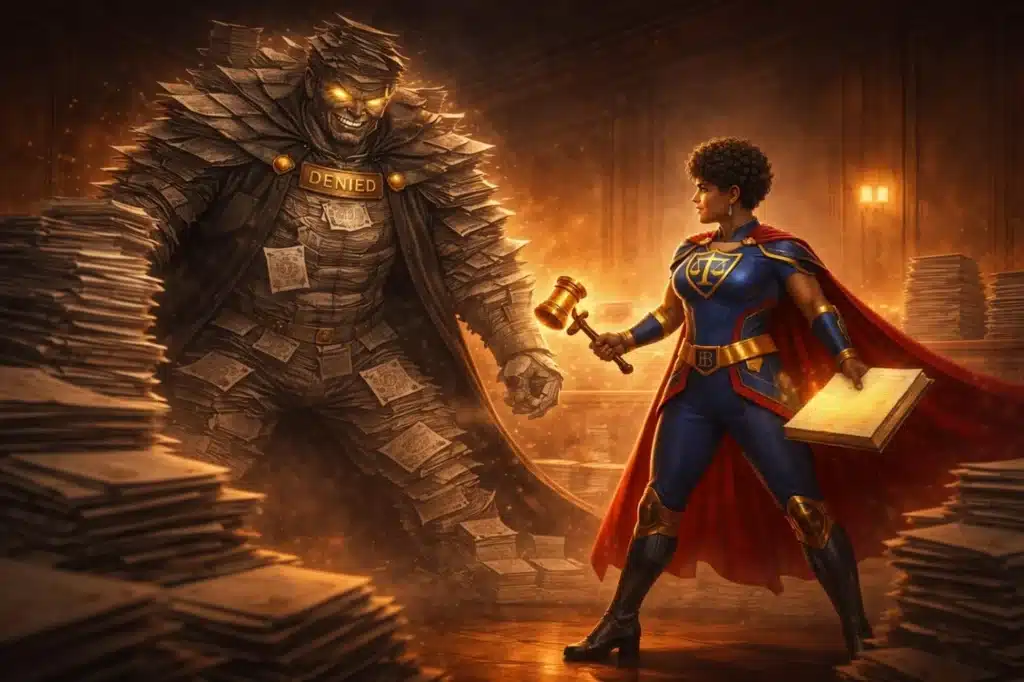
Then it stood.
The Denial Baron rose from the stack—tall, broad, and composed of stamped forms, rejected filings, and neatly folded letters bearing the same quiet word:
DENIED.
His presence was oppressive without being loud. No rage. No threat.
Just certainty.
Lady Law met his gaze without hesitation.
“So,” she said calmly. “You’re the one behind the backlog.”
The Denial Baron smiled—not cruelly, not mockingly—but with practiced patience.
“I prefer to think of myself as inevitable,” he replied. His voice was smooth, bureaucratic, endlessly rehearsed. “Most people never make it this far.”
Gav vibrated.
I already hate him.
The Baron gestured lazily toward the files. “They try. They wait. They misunderstand a deadline or two. And eventually…” He shrugged. “They stop.”
Lady Law stepped forward.
She was in full costume now—not newly revealed, not dramatic—but present, unmistakable. The gold trim caught the low light. The scales on her breastplate gleamed steadily, unmoved by shadow.
“That only works,” she said, “when no one challenges you.”
The Baron chuckled softly. “Challenge requires energy. Hope requires endurance. I remove both.”
The air thickened.
The Legal Pad trembled in Lady Law’s other hand.
This one hides things on purpose, it whispered. I don’t like that.
Lady Law placed the pad on the table and opened it.
The pages stayed blank.
The Baron raised an eyebrow. “You see?” he said gently. “Even your tools recognize futility.”
Lady Law didn’t react.
She lifted Gav.
Not to strike.
Just to be seen.
You talk too much, Gav said pleasantly.
Golden light spread—not explosively, not violently—but insistently. The files around the Baron shifted, edges fraying, stamps cracking under scrutiny.
The Baron frowned for the first time.
Lady Law spoke, her voice steady.
“You depend on people believing they’re alone,” she said. “Believing delay is their fault. Believing denial is final.”
She flipped the Legal Pad open again.
This time, it wrote.
Slowly.
Deliberately.
Missing notice.
Improper standard.
Unlawful delay.
The Baron stepped back, just slightly.
“That’s not how this works,” he said sharply.
“It is now,” Lady Law replied.
She didn’t advance.
She didn’t attack.
She simply stood her ground.
The Covenant flared faintly behind her, forming a subtle ring of light that refused to shrink.
The Baron gathered himself, straightening his paper-laden shoulders.
“This isn’t over,” he said, his voice tightening. “There are others. Systems within systems. Time itself bends in my favor.”
Lady Law smiled—not warmly, not kindly—but confidently.
“I don’t rush,” she said. “And I don’t quit.”
Gav hummed with satisfaction.
That’s usually when they leave.
The Baron dissolved—not destroyed, not defeated—but withdrawn, sinking back into the stacks from which he came.
The pressure lifted.
The room breathed again.
Lady Law lowered Gav and closed the Legal Pad.
She knew better than to celebrate.
This wasn’t a victory.
It was a declaration.
As she turned toward the exit, the Covenant pulsed once—stronger now, more alert.
Somewhere deeper in the system, something older than delay and denial took notice.
Lady Law had named the enemy.
And the enemy knew her name.
Chapter Six: Adjuster Zero
Adjuster Zero did not arrive.
He initialized.
Lady Law felt it as a sudden chill—not in temperature, but in tone. The warmth that usually lingered in a room when people spoke about their cases vanished, replaced by something sterile and exact.
Numbers had entered the conversation.
She stood at the table, fully in costume, gold trim catching the fluorescent courtroom light. Gav rested easily in her hand. The Legal Pad lay open, alert but quiet.
Across from her, the man did not look like a villain.
That was the point.
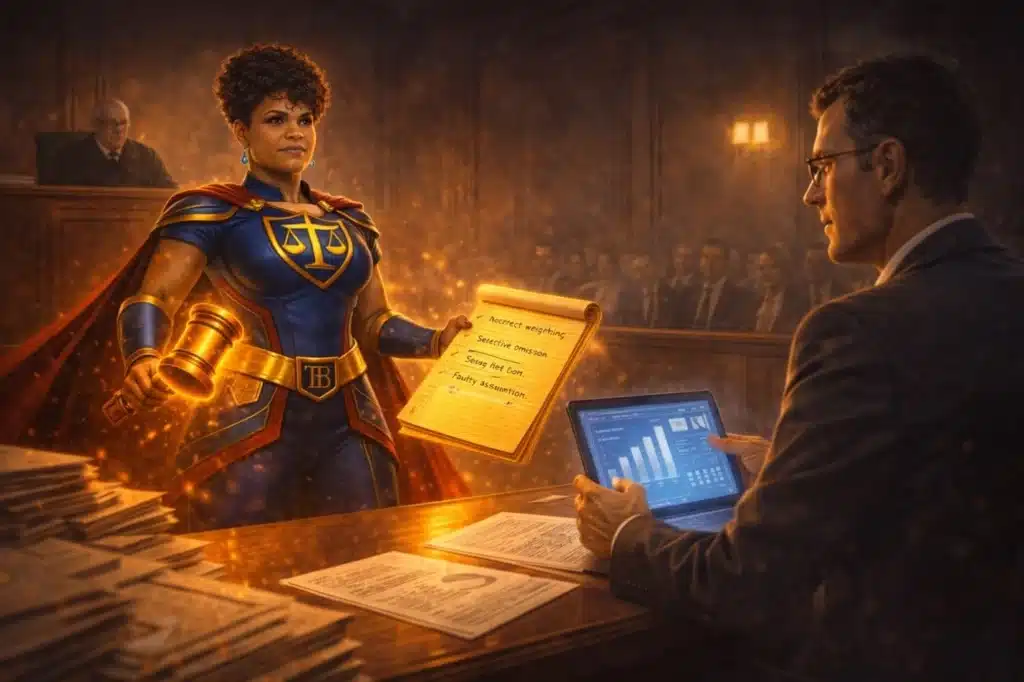
Adjuster Zero wore a perfectly pressed suit. His hair was neat. His expression polite. He smiled the way someone does when they believe the outcome is already decided.
“Ms. Bishop,” he said smoothly. “I appreciate your passion. Truly. But let’s be realistic.”
Lady Law tilted her head slightly.
“Realistic,” she repeated.
Zero tapped his tablet, the screen glowing with charts and percentages. “The numbers simply don’t justify continued review. The likelihood of approval falls below acceptable thresholds. Resources must be allocated efficiently.”
Gav hummed softly.
I dislike people who call surrender ‘efficiency.’
Lady Law didn’t interrupt.
She listened.
Zero continued, warming to his own logic. “This isn’t personal. It’s math. We remove emotion, we remove bias. We arrive at truth.”
He looked up, confident.
Lady Law smiled.
“That’s an impressive presentation,” she said calmly. “But your math is incomplete.”
Zero blinked once. “I beg your pardon?”
“You removed emotion,” she said. “But you also removed context. And people don’t live in spreadsheets.”
The Legal Pad slid forward.
Oh good, it whispered. A numbers person.
Lady Law gestured toward the tablet. “Your model assumes averages,” she said. “But my client is not an average. He’s a person with a documented history, specific limitations, and evidence you conveniently rounded down.”
Zero’s smile tightened. “Outliers are statistically insignificant.”
Lady Law leaned in slightly—not aggressively, but decisively.
“Not in a courtroom.”
She lifted the Legal Pad.
The numbers on Zero’s tablet flickered.
“What are you doing?” he demanded.
“Restoring variables,” Lady Law replied.
The pad began to write—clean, precise, merciless.
Incorrect weighting.
Selective omission.
Faulty assumption.
Zero’s screen recalculated itself without permission.
Percentages shifted.
Risk assessments spiked.
“That’s not possible,” he said, tapping frantically.
Gav glowed brighter.
I love when math has feelings.
Lady Law spoke again, her voice firm but measured. “You treat human suffering like a cost to be minimized. But the law doesn’t exist to optimize profits. It exists to protect people.”
Zero looked up, anger flashing through his composure. “You’re being sentimental.”
“No,” Lady Law said. “I’m being accurate.”
She turned the Legal Pad so the judge could see.
Silence fell.
The judge studied the page, then glanced at Zero. “These calculations,” he said slowly, “appear… selective.”
Zero swallowed.
Lady Law didn’t press.
She didn’t need to.
The system was correcting itself.
Zero straightened his jacket, composure cracking just enough to reveal frustration beneath. “This isn’t over,” he said quietly. “There are limits. Budgets. Constraints.”
Lady Law nodded. “There are. And then there are rights.”
She closed the Legal Pad.
Gav dimmed, satisfied.
Another equation balanced.
As Zero gathered his things, his movements were no longer smooth. The certainty that had insulated him was gone, replaced by something unfamiliar.
Doubt.
Lady Law watched him leave without triumph.
She knew his kind.
He would return.
Numbers always did.
But for now, the room breathed again.
Lady Law stepped back, the Covenant pulsing steadily around her—not flaring, not celebrating.
Justice wasn’t about winning arguments.
It was about reminding the system what it was built to serve.
And she wasn’t finished reminding it yet.
Chapter Seven: The Long Wait
The Delay did not rush.
He never did.
Lady Law felt him before she saw him—an invisible drag on momentum, a weight that turned simple steps into effort. Calendars thickened. Deadlines softened. What should have moved stalled instead.
The system slowed.
Phones rang longer before being answered. Letters took weeks to arrive. Hearings were rescheduled without explanation.
Time itself had become hostile.
Lady Law stood in her office, still in costume, hands braced against her desk. The gold trim no longer glowed brightly—it held steady, restrained, as if conserving energy.
Gav rested nearby, unusually quiet.
I don’t like this one, he finally said. There’s nothing to hit.
The Legal Pad lay open, its pages restless.
He’s stretching everything, it whispered. Moments. Meaning. Hope.
Lady Law exhaled slowly.
“Then we don’t give him space,” she said.
She moved.
Every action became deliberate. Motions filed early. Follow-ups sent before they were requested. Calls returned the same hour they were made.
No pauses.
No gaps.
Somewhere deep within the system, chains rattled.
The Delay emerged gradually—not as a figure, but as an atmosphere. Hallways felt longer. Waiting rooms heavier. Clients sat longer in chairs that seemed designed to drain resolve.
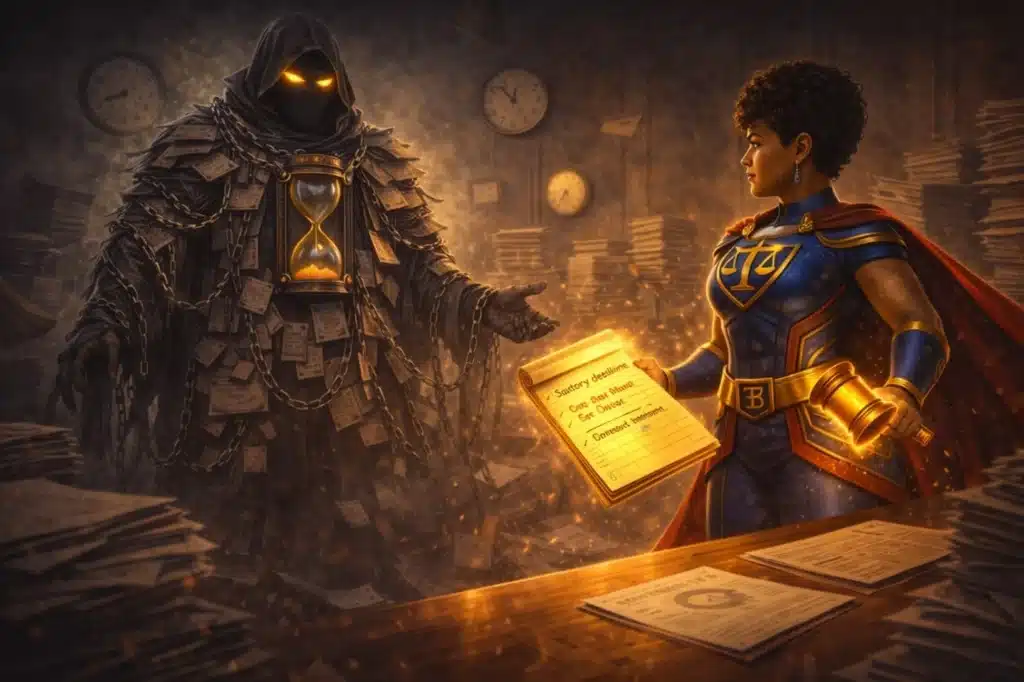
When he finally appeared, it was beside a frozen clock.
His form was draped in shredded paperwork and ticking mechanisms. An hourglass hung at his chest, sand falling painfully slow.
“You work so hard,” he said, his voice smooth and unhurried. “Why not rest?”
Lady Law met his gaze.
“Because people are waiting.”
He smiled gently. “They always are.”
The Delay lifted a hand, and the clock stopped completely.
Fatigue crept in. Not dramatic exhaustion—something worse. The kind that whispered tomorrow.
Gav dimmed. I can’t call order if time itself won’t move.
Lady Law stepped forward anyway.
She reached into her briefcase and pulled out her calendar.
Dates glowed.
Deadlines sharpened.
“This ends here,” she said.
The Delay tilted his head. “Deadlines are suggestions.”
“Not when enforced,” Lady Law replied.
The Legal Pad snapped to attention.
Statutory deadline, it wrote boldly.
Court-ordered timeframe.
The sand in the hourglass shuddered.
The Delay frowned.
Lady Law pressed on—motion after motion, filing after filing. No drama. No speeches. Just relentless forward movement.
The Covenant pulsed brighter.
Chains around the Delay’s limbs began to crack—not shatter, but weaken.
“You’re tiring yourself,” he warned.
Lady Law smiled.
“I don’t get tired of this.”
The Delay stepped back for the first time.
Time lurched forward.
The clock resumed its ticking.
The weight lifted—not gone, but diminished.
The Delay faded, his form unraveling into loose pages and slipping sand.
“This isn’t over,” his voice echoed. “People always stop eventually.”
Lady Law gathered her things.
“I don’t,” she said.
As she walked away, the Covenant burned steady and bright.
Because justice didn’t arrive on its own.
It had to be pursued.
Again.
And again.
And again.
Chapter Eight: Momentum

Momentum did not arrive all at once.
It built.
Lady Law felt it in the way doors opened more quickly. In the way returned calls came without reminders. In the subtle shift of posture from people who had once assumed delay was unavoidable.
The system was no longer drifting.
It was moving.
She stood at the center of it, fully in costume now—not newly revealed, not ceremonial—but activated. The gold trim of her suit pulsed softly with each step, the scales on her breastplate steady and balanced.
Gav gleamed in her hand.
Ah, he said with satisfaction. This is my favorite phase.
The Legal Pad rested against her forearm, pages already warm with anticipation.
Forward motion is very healthy, it added. For everyone except villains.
Lady Law moved through the courthouse like a current. Each filing landed on time. Each deadline was met early. Each argument was tightened until there was nowhere left to hide.
The Delay felt it first.
He appeared briefly at the end of a hallway, his hourglass cracked now, sand slipping faster than before. His chains rattled as Lady Law passed without slowing.
“You can’t keep this pace,” he warned weakly.
She didn’t turn.
“Yes,” she said calmly. “I can.”
The Legal Pad flipped open mid-stride.
Statutory compliance achieved, it wrote.
Further delay unjustifiable.
The Delay faltered.
Time lurched forward again.
Further down the hall, Adjuster Zero recalculated.
Lady Law entered the room before he finished.
His screens glitched. Numbers refused to settle.
“You’re exceeding projections,” he said, irritation replacing precision. “This level of persistence is inefficient.”
Lady Law placed the Legal Pad on the table.
“Efficiency without justice,” she replied, “is just neglect.”
The pad underlined it twice.
Gav hummed approvingly.
Zero’s models collapsed inward, logic turning against itself as human reality refused to be rounded away.
He stepped back.
Not defeated—but no longer in control.
And then there was the Denial Baron.
He loomed at the far end of the chamber, stacks of rejected files thinner now, posture less assured. Stamps cracked under pressure, ink bleeding into irrelevance.
“You are disrupting a carefully balanced system,” he said sharply.
Lady Law stopped.
She finally faced him fully.
“No,” she said. “I’m restoring it.”
She raised Gav—not to strike, but to declare.
Order, Gav said quietly.
The word rolled through the chamber, snapping timelines into alignment, forcing decisions to surface instead of hiding beneath procedure.
The Covenant flared brighter than it ever had—not blinding, not destructive—but undeniable.
The Baron staggered.
Paper peeled away from him, revealing gaps where certainty once lived.
“This ends now,” Lady Law said.
Not as a threat.
As a fact.
The room held its breath.
And then—
Movement.
Decisions issued. Hearings scheduled. Orders signed.
Momentum surged.
The villains didn’t vanish.
They retreated.
Lady Law lowered Gav and closed the Legal Pad.
She knew better than to think the fight was finished.
But it was turning.
As she walked out of the chamber, the Covenant settled into a steady, confident glow.
Justice wasn’t rushing.
It wasn’t waiting.
It was moving forward—because someone had refused to let it stall.
Lady Law paused briefly at the doorway, looking back at the system she had forced into motion.
“Good,” she said softly.
And then she kept going.
Chapter Nine: Judgment
The courtroom was full.
Not just with people—but with consequence.
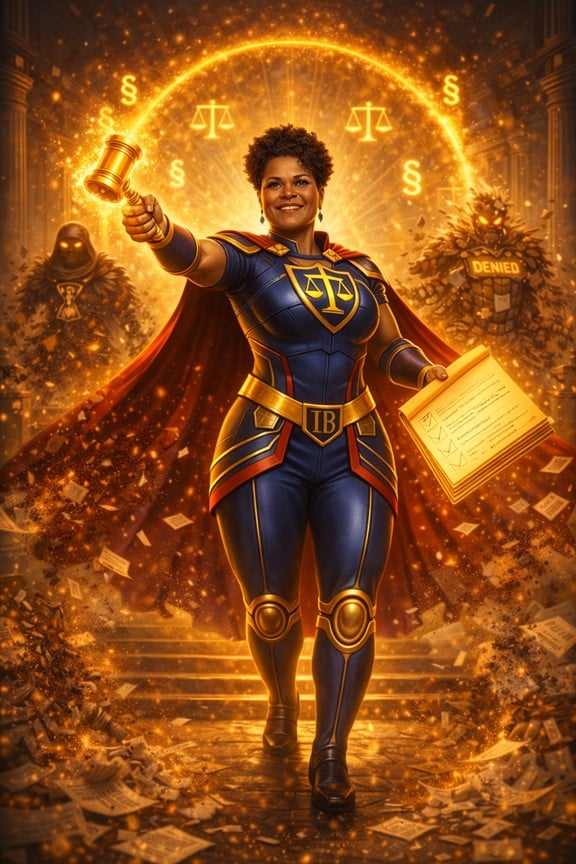
Lady Law stood at the center of it, fully revealed now, her uniform no longer merely activated but complete. The gold trim burned steady and bright. The scales on her breastplate gleamed with perfect balance, neither tipping nor trembling.
Behind her, the Covenant of Justice formed a luminous ring—visible now, undeniable.
This was no longer a quiet correction.
This was judgment.
The Denial Baron loomed across the chamber, diminished but defiant. His form was thinner than before, stamped pages peeling away under the weight of exposure. The words DENIED flickered and faded across his surface, losing their authority.
“You push too far,” he said, his voice strained. “Systems exist for a reason.”
Lady Law did not raise her voice.
“Systems exist to serve people,” she replied. “Not exhaust them.”
Gav glowed brilliantly in her hand.
Ah, he said with satisfaction. Final arguments. My favorite.
The Legal Pad floated forward, pages already turning.
The record is… extensive, it noted. And very unkind to you.
The Baron sneered. “You think clarity defeats power? Delay? Calculation?”
Lady Law took one step forward.
With it, timelines snapped into alignment. Dates locked. Deadlines crystallized. Every attempt to stall or obscure collapsed under its own weight.
“You hid behind confusion,” she said. “You relied on fatigue. You counted on silence.”
She raised the Legal Pad.
The pages flared gold.
Improper denial.
Unlawful delay.
Corrective action required.
The judge leaned forward, eyes wide.
The Baron staggered.
“This isn’t how it works,” he protested weakly.
“It is now,” Lady Law said.
She lifted Gav.
Not in anger.
In authority.
Order, Gav declared.
The word thundered—not loud, but absolute. It rippled through the courtroom, binding the facts, sealing the record, forcing truth into the open where it could no longer be avoided.
The Covenant surged.
Paper tore away from the Denial Baron, revealing emptiness beneath—no malice, no intelligence, just a hollow mechanism fueled by neglect and indifference.
The Baron fell to his knees.
The judge spoke, voice firm and clear. “Judgment is entered.”
The words landed like a final seal.
The Denial Baron dissolved—not destroyed, not punished—but rendered powerless. His fragments scattered into harmless scraps, no longer capable of blocking a single path forward.
Silence followed.
Then breath.
Lady Law lowered Gav.
The glow softened.
The Covenant dimmed—not gone, but satisfied.
She turned—not to the judge, not to the room—but to her client, who stood frozen at the edge of it all.
“It’s done,” Lady Law said gently.
Tears fell. Relief followed. Hope returned—tentative, then real.
As the courtroom emptied, Gav sighed contentedly.
Well, he said. That was extremely orderly.
The Legal Pad closed itself with a soft snap.
Justice documented, it added.
Lady Law stood alone for a moment, the echoes of judgment still resonating in the walls.
She looked around—not with pride, not with triumph—but with resolve.
Because this wasn’t the end of the work.
It was proof that it mattered.
And as she turned toward the door, the Covenant of Justice pulsed once more—steady, enduring.
Judgment had been rendered.
And Lady Law was not finished.
Chapter Ten: Cookies and Closure

The courthouse was quiet again.
Not the tense quiet of waiting.
Not the heavy quiet of defeat.
The good kind.
Lady Law stood at the top of the steps, the morning sun warming the stone beneath her heels. The Covenant of Justice had faded back into its resting state—no glow, no ring of light—just a steady presence, satisfied.
She was back in her business suit now.
No cape.
No armor.
Just authority.
Gav rested comfortably in her bag, unusually silent.
“You okay in there?” she asked softly as she walked.
I’m processing, he replied. That was… very orderly.
She smiled.
At the bottom of the steps, she paused and reached into the passenger seat of her car, lifting a neatly wrapped box. The scent escaped immediately—warm, familiar, unmistakable.
Cookies.
Chocolate chip.
Gav groaned. You’re not serious.
“Oh, I’m very serious,” Lady Law said.
She drove across town, not to a courthouse or an office, but to a plain, unremarkable building—the kind where decisions were usually made without eye contact.
Inside, the atmosphere was different now.
Lighter.
A receptionist looked up, startled, then stood straighter. “Ms. Bishop?”
“Yes,” Lady Law said pleasantly. “I’m here to drop something off.”
She set the box gently on the counter.
“What’s this?” the receptionist asked.
“Closure,” Lady Law replied.
The Legal Pad shifted in her bag.
I like her style.
Down the hallway, a familiar figure appeared—no longer towering, no longer composed of certainty and stamped authority. Just a person now. Tired. Humbled.
The former agent hesitated. “You didn’t have to do this.”
“I know,” Lady Law said kindly. “That’s why I did.”
She didn’t gloat.
She didn’t lecture.
She simply nodded once and turned back toward the door.
Behind her, Gav sighed.
Well, he said. I suppose mercy is efficient in its own way.
Lady Law laughed softly as she stepped outside.
Later that afternoon, she returned to her office. A client waited inside—smiling now, standing taller than when they had first met.
“It’s done,” the client said, disbelief still coloring their voice.
Lady Law nodded. “It is.”
“Thank you,” they said. “I don’t know how to—”
“You don’t have to,” she replied gently. “Just live your life.”
After they left, Lady Law sat at her desk, the day finally slowing.
She placed Gav beside her.
The Legal Pad lay closed, peaceful.
The city outside continued on—unaware of what had been set right.
Lady Law leaned back and exhaled.
Justice hadn’t thundered.
It hadn’t burned the world down.
It had arrived quietly.
Prepared.
Persistent.
Human.
She glanced at the remaining cookie in the box and smiled.
“Save one?” she asked.
Gav snorted. Obviously.
Lady Law reached for it and took a bite.
Somewhere, the Covenant rested.
And somewhere else, a system worked a little better than it had the day before.
Because Lady Law had shown up.
And she always would.