
If you or someone you care for is unable to work due to Sjögren’s syndrome, read on for how SSA will evaluate your claim for Social Security Disability benefits.
The Bishop Law Firm has represented disabled clients since 2009, and we do not get paid unless we win.
Our attorney, Kimberly Bishop, is a North Carolina Board Certified Social Security Disability Law Specialist.
Call us today for a free case review, (919) 615-3095, or start online now.

Overview of Social Security Disability Benefits
As with everything, the first step—applying for benefits at the initial level—is the most important.
You can apply online (Apply for Disability) or by calling your local SSA office (SSA Office Locator).
If you are unable to work because of Sjögren’s syndrome, apply as soon as possible, as delay may cause you to lose benefits.
Types of SSA Disability Benefits

Social Security offers two (generally) types of benefits for disabled people: Social Security Disability Insurance Benefits (SSDI) and Supplemental Security Income (SSI).
Social Security Disability Insurance
SSDI is based on the credits from the work you have done in your life and is comparable to the amount you would receive in retirement benefits if you waited until your full retirement age to retire.
In general, you must have worked 5 out of the last 10 years to be eligible for SSDI.
Supplemental Security Income
SSI is a need-based program that has income and asset requirements (Read Who can get SSI? for more information).
In 2025, the SSI monthly payment is $967 a month for an individual and $1,450 for a couple.
SSA will reduce the monthly SSI payment amount if you are receiving financial assistance from others.
Even if SSA allows you to apply for SSDI and SSI initially, they can send you an instant denial if you are determined to be ineligible for either type of benefit.
The Disability Appeals Process

Attaining Social Security Disability can be a lengthy process. Denials are common, and appeals are often necessary to attain disability benefits.
There are several levels that you may have to go through to get your claim approved: Initial, Reconsideration, Request for Hearing, the Appeals Council, and District Court.
At each of the above levels, your claim will be evaluated by SSA (or DDS) under the Five Step Sequential Evaluation to determine if you are disabled:
- Step 1 – Are You Working? The Social Security Administration defines work as “Substantial Gainful Activity” (SGA). SGA is roughly defined as work from earnings that average more than $1,620 per month (as of 2025). If you can perform substantial gainful activity, you generally will not qualify for disability benefits.
- Step 2 – Is Your Condition “Severe”? Severity is key when determining what qualifies as a disability. Severe is defined by the Social Security Administration as: your condition must interfere with basic work-related activities for your claim to be considered.
- Step 3 – Is Your Condition on the List of Disabling Conditions? The Listings are very hard to meet in most cases, and not always interpreted as a shared reading would suggest. If you meet a listing, you are gravely ill. The listings are found here.
- Step 4 – Can You Do the Work You Did Previously? The Social Security Administration will look at your work history and determine if it was sedentary, light, medium, or heavy. They will also evaluate the skill level: unskilled, semi-skilled, and skilled. For instance, an attorney would be sedentary skilled work. The Dictionary of Occupational Titles is found here.
- Step 5 – Can You Do Any Other Type of Work? If the Social Security Administration determines that you can no longer perform your previous duties, they then assess whether you can still perform other tasks based on your residual functional capacity. This is where the “grids” come into play. The grids are the Medical-Vocational Guidelines. The grids are only for exertional impairments. The grids do not consider non-exertional impairments. If you are found to be capable of any other work, you will be found not disabled. Read The Grids and Your Social Security Disability Case.
Also read The SSA Five Step Sequential Evaluation for more information.
What is Sjögren’s syndrome?
The exact cause of Sjögren’s syndrome is unknown. Still, it appears that there is a genetic component that is triggered by a catalyst, such as a viral or bacterial infection (via JH).
As with all autoimmune disorders, the body's immune system mistakenly attacks itself. The eyes and mouth can be the first areas affected by Sjögren’s syndrome.
Peripheral neuropathy and elevated levels of dental caries can also be early symptoms of Sjögren’s.
Sjögren’s is challenging to diagnose. Specific antibodies must be present in the blood (anti-SSA or anti-Ro), along with signs of inflammation on the salivary glands of the lips (lip biopsy), for a doctor to make a diagnosis.
Up to 40% of patients are not positive for anti-SSA and are seen as “seronegative,” making diagnosis harder (via SF).
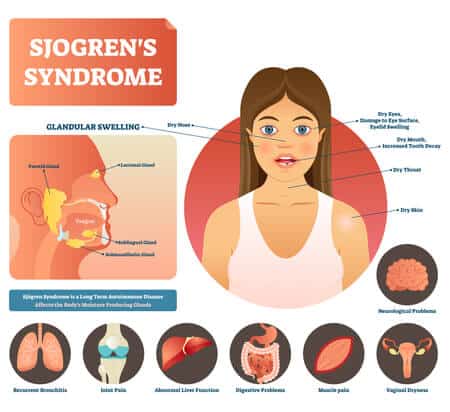
Sjögren’s syndrome frequently co-occurs with other autoimmune disorders, such as Rheumatoid Arthritis (inflammatory arthritis) and Systemic Lupus Erythematosus.
Read more at Rheumatoid Arthritis & Lupus.
Women over 40 years of age are at an increased risk of having Sjögren’s (Mayo Clinic).
While some may believe that Sjögren’s syndrome is a rare disease, it is actually one of the most prevalent autoimmune disorders (Sjögren’s Foundation).
As a systemic autoimmune disease, constitutional symptoms can range from dry eyes, dry mouth, difficulty swallowing due to reduced saliva production, cognitive dysfunction, mood disorders, severe fatigue, and chronic joint pain to whole organ system (e.g., central nervous or gastrointestinal system) dysfunction.
Symptoms can range from mild to severely disabling, and early treatment helps the long-term outcome.
Treatments can range from eye drops to Plaquenil and immunosuppressants (e.g., Prednisone or Methotrexate), each with its own disabling side effects (American College of Rheumatology) that can affect the ability to work.
Is Sjögrens a disability to SSA?
Yes, Sjögren’s syndrome can be a disability to the Social Security Administration.
But being diagnosed with Sjögren’s syndrome (or any impairment) will not guarantee approval for disability benefits.
Medical evidence demonstrating your functional limitations and the severity of your symptoms is more important than the name of your disorder.
Sjögren’s syndrome symptoms can range from mild to severely disabling. If you only suffer from mild symptoms, the likelihood of being approved for Social Security Disability is low.
SSA can use the Listing of Impairments, the Medical Vocational Guidelines (Grids), or a combination of your impairments to find you disabled.
Listing 14.10
The Social Security Administration needs your medical history, medical findings, and results of laboratory blood tests to show that you have an autoimmune disease (medically determinable impairment).
Once the objective evidence demonstrates the clinical presentation and diagnoses of Sjögren’s syndrome, SSA will evaluate disability claims under its Listing of Impairments.
In the Listings of Impairments, SSA has 14.10 Sjögren’s syndrome. However, this listing (as are most listings) is hard to meet.
Listing 14.10 requires involvement of two or more body systems with at least one of those symptoms being involved to a moderately severe level with at least two symptoms (severe fatigue, fever, malaise or involuntary weight loss) OR repeated manifestations of Sjögren’s syndrome with two of the constitutional sympotms and one of the following: limitation in activities of daily living, social functioning or completing tasks in a timely manner.
If you meet this listing, you are experiencing chronic pain and severe symptoms that make work the last thing on your mind.
The Medical Vocational Guidelines (The Grids)
The Grids may help people who are 50 years of age or older whose Sjögren’s has affected their ability to walk, stand, and lift due to fatigue or other subjective symptoms.
Anyone under the age of 50, the highly educated, and those with a skilled work history will find little help here.
A combination of your impairments
Lastly, SSA can use the combination of your impairments to find that you are unable to work.
People with Sjögren’s often have other immune system disorders. Around half the Sjögren’s patient population also has Rheumatoid Arthritis or Lupus.
The combination of symptoms from your autoimmune disorders can definitely render you disabled, especially when high doses of immunosuppressants must be used to control symptoms.
Do you need a Social Security Disability Lawyer for Sjögren’s syndrome?
If your Sjögren’s syndrome is preventing you from working, you should apply for Social Security Disability benefits as soon as possible. Delay may cause you to lose benefits.
If you have applied for disability and received an initial denial, a disability lawyer can help you appeal. Oftentimes, our clients have to be persistent in order to be found disabled.
We understand that the process can be difficult, but if you cannot work, you cannot give up.
The Bishop Law Firm represents Social Security Disability clients in Raleigh, Durham, Fayetteville, Cary, Rocky Mount, Wilson, Smithfield, Louisburg, Chapel Hill, Roanoke Rapids, Winston Salem, Garner, Greensboro, Greenville, and surrounding areas in North Carolina. Call us today for a free case review, (919) 615-3095, or start online now.