If you are looking for information on North Carolina Disability Determination services, read on. The Bishop Law Firm has represented Social Security Disability clients in North Carolina since 2009. We offer free case reviews and no fee unless you win. Call us now for your free case review or start online now.

Types of Social Security Disability Benefits
In general, SSA offers two types of Social Security Disability benefits: Social Security Disability Insurance and Supplemental Security Income.
Social Security Disability Insurance (SSDI)
SSDI is based on the credits from the work you have done in your life. You must be found disabled before your date last insured (DLI) to be found eligible for SSDI. Your DLI is calculated by counting your “quarters of coverage” from your earnings record. You must have 20 “quarters of coverage” of the last 40 quarters. Simply put, you must have worked for 5 years in the last 10 years (in general). In addition, Adult Disabled Children can be eligible for benefits from their parents’ account.
Supplemental Security Income (SSI)
SSI is a need-based program, and you must meet income/asset standards in addition to being found disabled. In 2026, SSI is $994.00 per month for an individual and $ 1,491.00 per month for an eligible couple. SSI will be reduced by 1/3 if you receive financial assistance from others. In NC, SSI recipients are also entitled to Medicaid.
After you apply for SSDI or SSI at your local North Carolina Social Security field office or online, your case is sent to Disability Determination Services for them to make a decision regarding your disability.
If you are denied at the initial and reconsideration levels by DDS, you will have to request a hearing before an Administrative Law Judge with SSA's Office of Hearing Operations. You can request a hearing by completing the 3441 SSA Disability Appeal Report or by filing an appeal online with the Social Security Administration.
What DDS Means for Your Disability Claim?
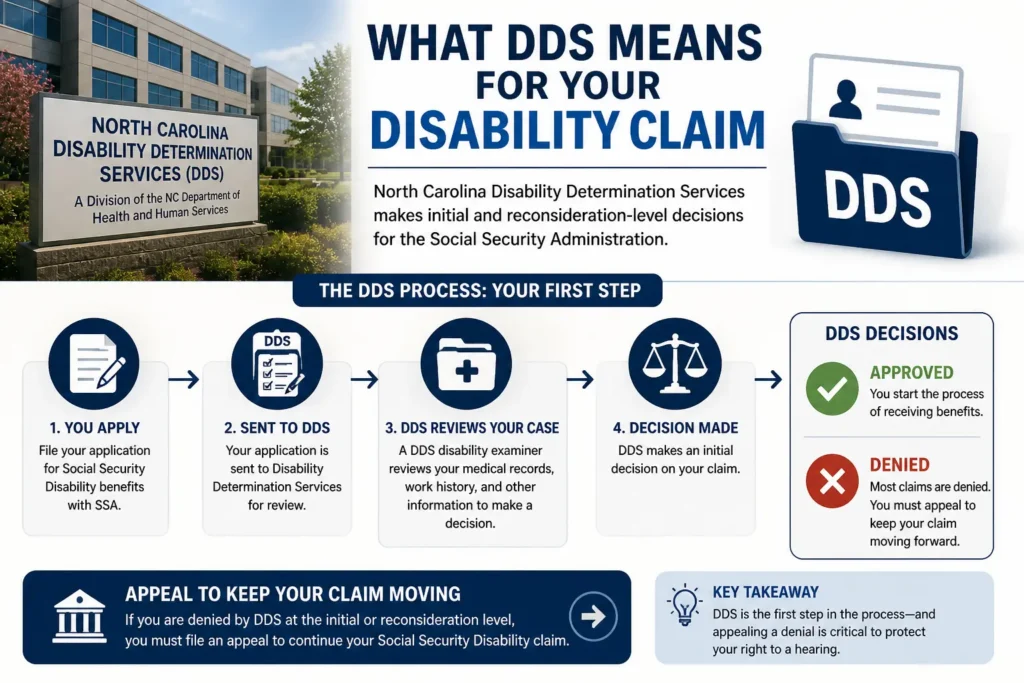
North Carolina Disability Determination Services makes initial and reconsideration-level decisions for the Social Security Administration.
DDS is the first stop in your disability claim after you file your application with SSA. As you will see below, DDS denies most of the cases it sees. If you are denied by DDS, you must appeal to keep your Social Security Disability claim moving forward.
Who is NC Disability Determination Services?
DDS is a division of the North Carolina Department of Health and Human Services. Funded primarily by the federal government’s Social Security Administration, DDS makes medical determinations for Social Security Disability, Supplemental Security Income, and North Carolina Medicaid Disability claims.
Even though DDS is located in Raleigh, NC (3301 Terminal Drive), it handles Social Security Disability claims for all North Carolina Social Security Field offices at the initial and reconsideration levels. Disability Determination Services phone number is (919) 814-3222 or 866-542-8113.
DDS denies 70+% of the claims it sees.
At DDS, a disability examiner will review your file, send you forms (i.e., work history forms and 3rd party questionnaires for your family to complete), and obtain evidence from your health care providers on your disability claim. They also may send you to a Social Security doctor for a physical or mental consultative examination.
If you are denied at the initial level, you have 60 days to file an appeal, known as a reconsideration. When you request reconsideration, your case will be sent to DDS again. A different examiner will review your case, send more forms for you to complete, and order more medical evidence if you have any. This examiner will then make a decision on your case. If you receive a denial at the reconsideration level, you have 60 days to request a hearing from the date of the reconsideration denial.
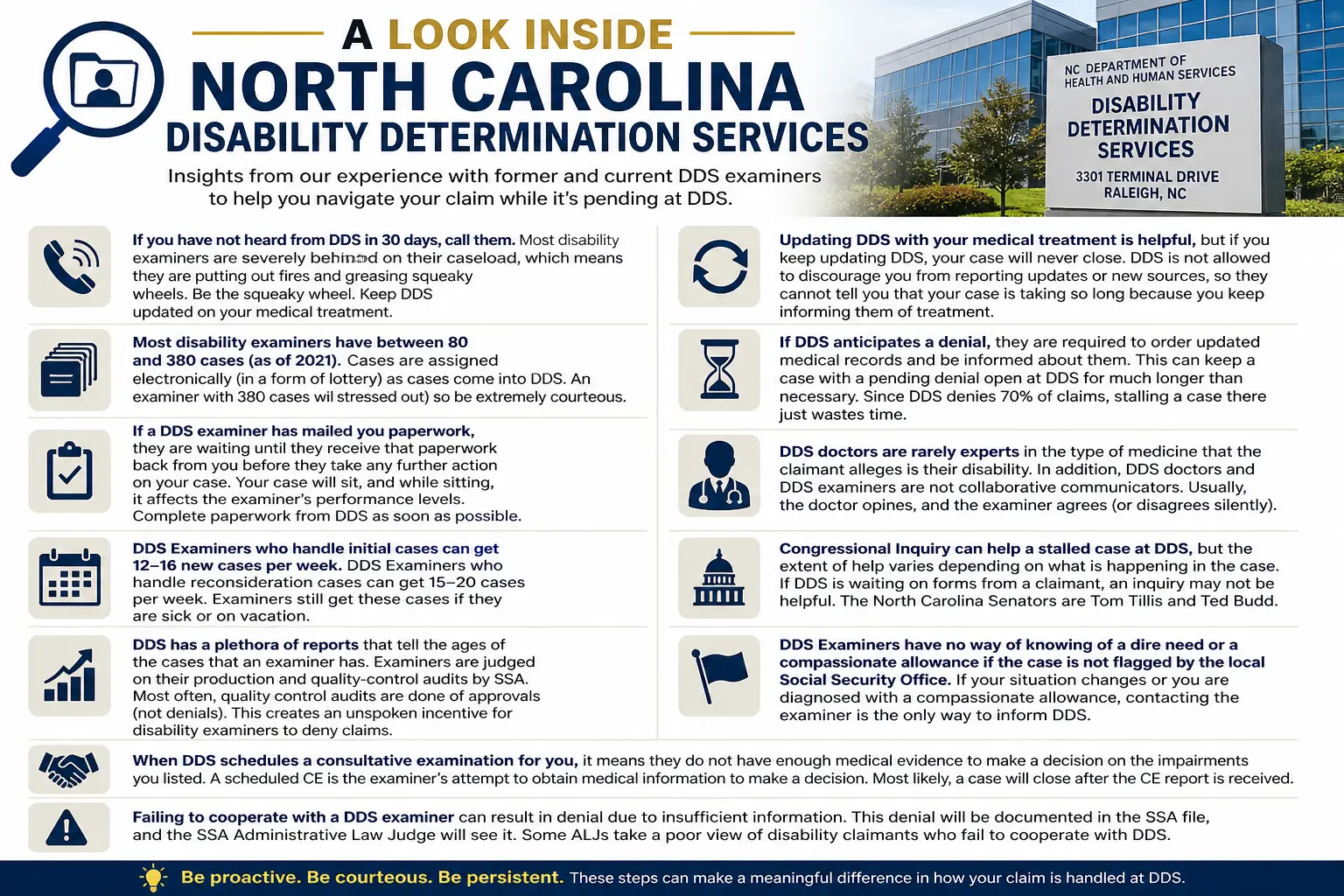
A Look Inside North Carolina Disability Determination Services
In our firm's Social Security Disability practice, we have had the good fortune of working with former DDS examiners, speaking with current DDS examiners, and learning how we can help our clients while their cases are pending with DDS.
- If you have not heard from DDS in 30 days, call them. Most disability examiners are severely behind on their caseload, which means they are putting out fires and greasing squeaky wheels. Be the squeaky wheel. Keep DDS updated on your medical treatment, especially if you begin seeing a new provider or have a new diagnosis.
- Most disability examiners have between 80 and 380 cases (as of 2021). Cases are assigned to examiners electronically (in a form of lottery) as cases come into DDS from the local Social Security Office. A disability examiner with 380 cases will be constantly behind (and extremely stressed out), so be extremely courteous if you ever get one on the phone.
- If a DDS examiner has mailed you paperwork, they are waiting until they receive that paperwork back from you before they take any further action on your case. Your case will sit, and while sitting, it affects the disability examiner's performance levels. Complete paperwork from DDS as soon as possible.
- DDS Examiners who handle initial cases can get 12-16 new cases per week. DDS Examiners who handle reconsideration cases can get 15-20 cases per week. Examiners still get these cases if they are sick or on vacation.
- DDS has a plethora of reports that tell the ages of the cases that an examiner has. Disability examiners are judged on their production and quality-control audits by the Social Security Administration. Most often, quality control audits are done of approvals (not denials). This creates an unspoken incentive for disability examiners to deny claims.
- Updating DDS with your medical treatment is helpful, but if you keep updating DDS, your case will never close. DDS is also not allowed to discourage a disability claimant from reporting updates or new sources, so they cannot inform you that your case is taking so long because you keep informing them of medical treatment.
- If DDS anticipates a denial, they are required to order updated medical records and be informed about them. Again, this can keep a case with a pending denial open at DDS for much longer than necessary. Since DDS denies 70% of claims, stalling a case there just wastes time.
- DDS doctors are rarely experts in the type of medicine that the claimant is alleging is their disability. In addition, DDS doctors and DDS examiners are not collaborative communicators. Usually, the doctor opines, and the examiner agrees (or disagrees silently).
- Congressional Inquiry can help a stalled case at DDS, but the extent of help varies depending on what is happening in the case. For example, if DDS is waiting on forms from a claimant, a congressional inquiry may not be helpful. The North Carolina Senators are currently Tom Tillis and Ted Budd.
- DDS Examiners have no way of knowing of a dire need or a compassionate allowance if the case is not flagged by the local Social Security Office. If the claimant's situation changes or they are diagnosed with a compassionate allowance, contacting the examiner is the only way to inform DDS.
- When DDS schedules a consultative examination for you, it means that they do not have enough medical evidence to make a decision on the impairments you listed on your application. A scheduled CE is the disability examiner's attempt to obtain medical information to make a decision on your claim. Most likely, a case will close after a consultative exam report is received.
- Failing to cooperate with a DDS examiner can result in denial due to insufficient information. This denial will be documented in the SSA file, and the SSA Administrative Law Judge will see it. Some Administrative Law Judges take a poor view of disability claimants who fail to cooperate with DDS.
Why Claims are Denied at DDS?
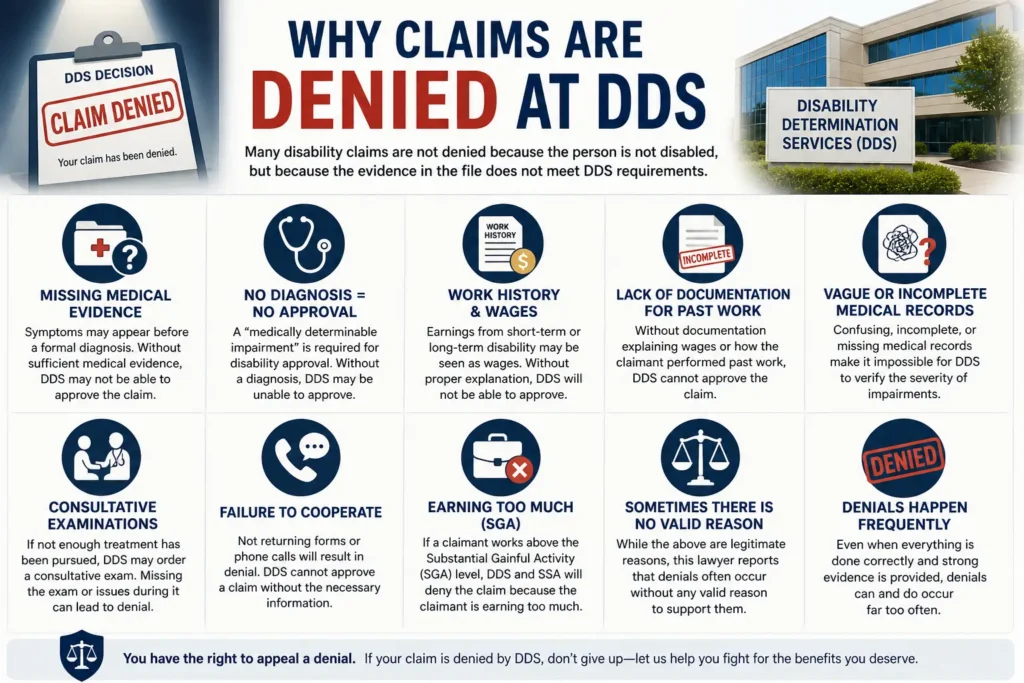
A disability claim can be denied at DDS for many reasons. Many disability claims are not denied because the person is not disabled, but because the evidence in the file does not meet DDS requirements.
Missing medical evidence is one of the main reasons. Unfortunately, symptoms of a condition may appear before a medical practitioner can provide a formal diagnosis.
Without a diagnosis, DDS may be unable to approve a claim, as a "medically determinable impairment" is required for disability approval.
Work history and wages must be explained to DDS for them to determine that someone is disabled. There may be earnings in a claimant's file that were from short-term or long-term disability that DDS may see as wages.
Without documentation explaining those wages or how the claimant performed their past work, DDS will not be able to approve a claim.
Vague medical records are also an issue. Unfortunately, some medical professionals write confusing medical records, and others won't even provide medical records when DDS asks. Without clear medical evidence of impairments and symptoms, DDS can not approve a claim.
If a claimant has not been seeking medical treatment on their own, DDS will likely want to refer them for a consultative examination. If the claimant fails to attend the consultative examination, behaves poorly during the exam, or attempts to exaggerate their symptoms, the doctor will report it to DDS.
In addition, failing to return requested forms or phone calls to DDS will result in denials. DDS cannot approve someone who will not cooperate, as they do not have the necessary evidence to do so.
If a claimant continues to work above the substantial gainful activity (SGA) level, DDS and SSA will find out and deny the claim because the claimant is earning too much.
While the above are legitimate reasons DDS may deny a disability claim, I often see denials that are not clearly supported by the evidence in the file.
Even with all the above information, denials can and do occur frequently.
Most people are denied at the initial and reconsideration levels for Social Security Disability benefits and must request a hearing to be approved. Moving a case through DDS quickly may be the move for younger individuals or those with only mental disabilities.
The Bishop Law Firm represents Social Security Disability clients in Raleigh, Durham, Fayetteville, Cary, Rocky Mount, Wilson, Smithfield, Louisburg, Chapel Hill, Roanoke Rapids, Winston Salem, Garner, Greensboro, Greenville, and surrounding areas in North Carolina.
Call us today for a free case review or start online now.
Also read NC Social Security Disability Lawyer