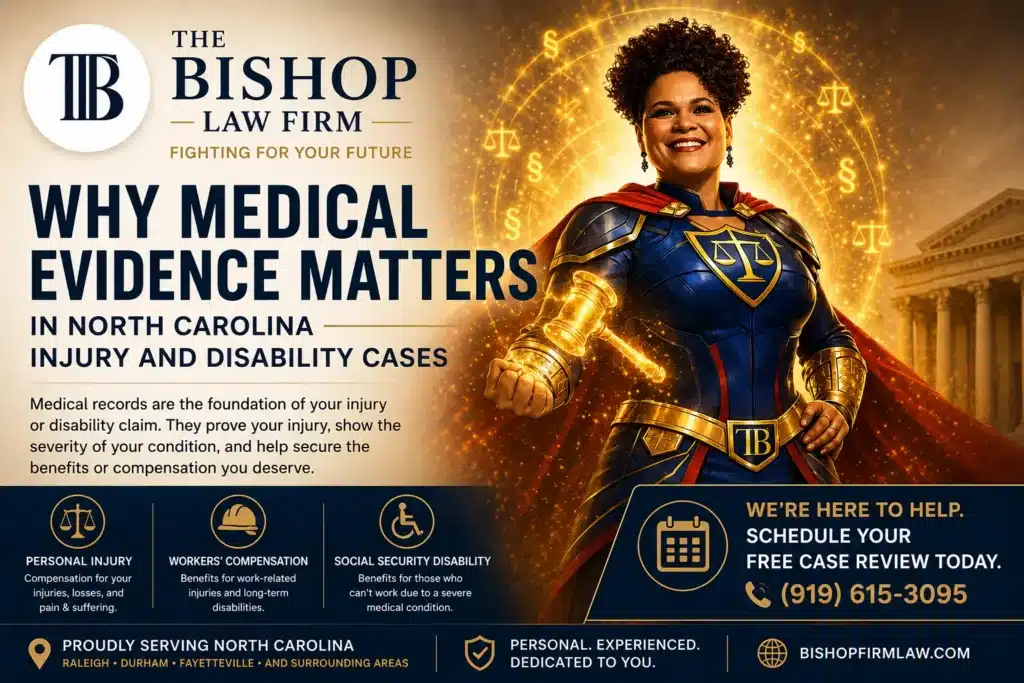
The Bishop Law Firm represents North Carolinians in Personal Injury, Workers' Compensation, and Social Security Disability cases. All three of these practice areas have a shared truth: medical evidence matters.
This article is for educational purposes only and is not medical advice. If you are experiencing a medical emergency, seek immediate medical care.

Why does medical evidence matter in disability and injury cases?
Medical treatment creates medical records. Medical records are the major source of evidence for determining if a client has been injured or is disabled.
The severity of an injury or disability is paramount to attaining benefits or compensation. Without medical evidence, you can not prove severity.
Without medical evidence showing injury or disability, a claim can fail or settle for far less than a victim deserves.
In addition to proving cases, a victim's or a disabled individual's health is of extreme importance.
Ignoring symptoms is rarely conducive to long-term health.
Personal Injury
Can I get compensation without medical treatment for my North Carolina Personal Injury?
Every case is different, but in our firm's opinion, the answer is no.
In North Carolina Personal Injury Cases, medical records are not only for proving that the defendant's negligence caused you harm, but the records are also used to determine the value of the harm sustained by the plaintiff.
The at-fault party is responsible for paying accident-related medical bills, lost wages, and pain & suffering resulting from the at-fault party’s negligent actions.
While case valuation can be complicated, medical evidence and thus medical billing help create a starting point for evaluating the actual financial, physical, and mental harm sustained by a victim.
In addition to current medical bills, lost wages, and pain & suffering, future damages should also be included in any settlement discussion.
Without medical records demonstrating the need for future treatment, a victim has no evidence needed to attain recovery for the future.
For a full discussion of Personal injury, read North Carolina Personal Injury Lawyer.
Workers' Compensation
Why is medical treatment important in North Carolina Workers' Compensation cases?
For North Carolina Workers' Compensation cases, an injury is required for a worker to even have a claim. While an incident may have occurred at work, that does not mean that the worker was injured.
Medical evidence establishes the worker's mechanism of injury and how that injury was caused during the course of their employment.
If a North Carolina Workers' Compensation claim is accepted, the employer (the workers' compensation insurance carrier) directs medical treatment.
An injured worker must attend all appointments and comply with medical advice to demonstrate the extent of their injury.
In a denied workers' compensation claim, medical treatment is even more important; it is the only way workers can prove they were injured at work and that their employer should pay for the injury.
Medical records also help establish a worker's permanent impairment, which is a major source of compensation in workers' compensation (disability rating).
Read an explanation of the difference between accepted vs. denied workers' compensation claims in North Carolina Workers' Compensation cases.
Social Security Disability
Can I win a disability case without medical records? In our firm's experience, the answer is no.
In Social Security Disability, the Social Security Administration will review a claimant's medical treatment for diagnosis, symptoms, treatments tried, and mental/physcial restrictions.
Social Security has a five-step sequential evaluation process. In Steps 2 and 3 of this process:
Step 2 – Is Your Condition “Severe”? Severity is key when determining what qualifies as a disability. Severe is defined by the Social Security Administration as: your condition must interfere with basic work-related activities for your claim to be considered.
Step 3 – Is Your Condition on the List of Disabling Conditions? The Listings are very hard to meet in most cases, and not always interpreted as a shared reading would suggest. If you meet a listing, you are gravely ill. The listings are found here.
Medical records are the only way to prove that a condition is severe and to determine whether it is found in the Listings.
The medical evidence analyzed at Steps 2 & 3 is then used to make findings at Steps 4 & 5:
Step 4 – Can You Do the Work You Did Previously? The Social Security Administration will look at your work history and determine if it was sedentary, light, medium, or heavy. They will also evaluate skill level as unskilled, semi-skilled, or skilled. For instance, an attorney would be sedentary skilled work. The Dictionary of Occupational Titles is found here.
Step 5 – Can You Do Any Other Type of Work? If the Social Security Administration determines that you can no longer perform your previous duties, they then assess whether you can still perform other tasks. This is where the “grids” come into play. The grids (Medical-Vocational Guidelines) are only for exertional impairments. The grids do not consider non-exertional impairments. If you are found to be capable of any other work, you will be found not disabled. Read The Grids and Your Social Security Disability Case.
Read more about Social Security Disability benefits
What if you can not afford medical treatment?
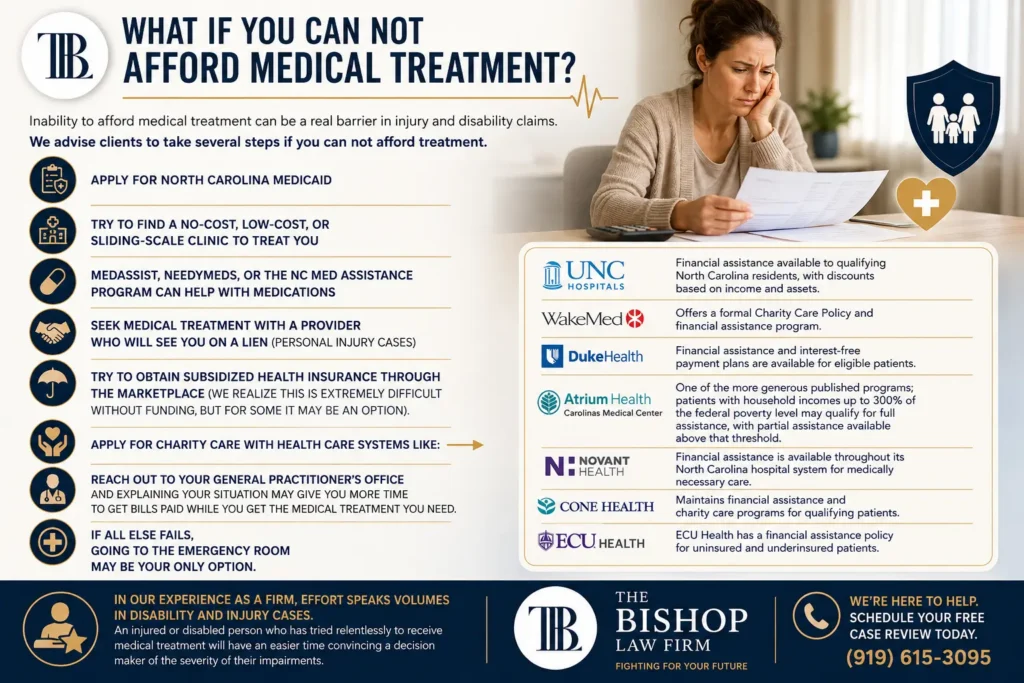
What if I cannot afford medical treatment after an accident or for my disability?
Inability to afford medical treatment can be a real barrier in injury and disability claims.
We advise clients to take several steps if they can not afford treatment.
- Apply for North Carolina Medicaid
- Try to find a no-cost, low-cost, or sliding-scale clinic to treat you
- MedAssist, NeedyMeds, or the NC Med Assistance Program can help with medications
- Seek medical treatment with a provider who will see you on a lien (personal injury cases)
- Try to obtain subsidized health insurance through the marketplace (we realize this is extremely difficult without funding, but for some it may be an option).
- Apply for Charity care with health care systems like:
- UNC Hospitals — Financial assistance available to qualifying North Carolina residents, with discounts based on income and assets.
- WakeMed Raleigh Campus — Offers a formal Charity Care Policy and financial assistance program.
- Duke Health — Financial assistance and interest-free payment plans are available for eligible patients.
- Atrium Health Carolinas Medical Center — One of the more generous published programs; patients with household incomes up to 300% of the federal poverty level may qualify for full assistance, with partial assistance available above that threshold.
- Novant Health — Financial assistance is available throughout its North Carolina hospital system for medically necessary care.
- Cone Health — Maintains financial assistance and charity care programs for qualifying patients.
- ECU Health has a financial assistance policy for uninsured and underinsured patients.
- Reaching out to your general practitioner's office and explaining your situation may give you more time to get bills paid while you get the medical treatment you need.
- If all else fails, going to the Emergency Room may be your only option.
In our experience as a firm, effort speaks volumes in disability and injury cases. An injured or disabled person who has tried relentlessly to receive medical treatment will have an easier time convincing a decision maker of the severity of their impairments.
Can an attorney help me get medical treatment?
The Bishop Law Firm frequently points clients in the right direction for obtaining medical treatment, but generally does not refer clients to specific doctors.
Nor do we pay for client medical treatment out of pocket or give loans for clients to seek medical treatment.
While we do help clients obtain medical treatment when ethically permissible, using specific doctors for Social Security Disability claims can raise concerns about dishonesty and lead to backlash from the Social Security Administration.
In general, it is advisable for a disabled or injured victim to seek medical treatment on their own with doctors that they feel provide the best medical treatment for them, except when they are directed to certain medical providers (as in consultative exams for Social Security Disability or authorized treating physicians in North Carolina Workers' Compensation cases).
How can The Bishop Law Firm help me?
The Bishop Law Firm has represented clients in disability and injury claims throughout North Carolina since 2013.
While no attorney can promise a win, we know the evidence that the Social Security Administration, Superior Court Judge/Jury, and the North Carolina Industrial Commission need to see in order to make the correct decision on your claim.
We work with our clients to ensure their cases are heard and properly evaluated by presenting the right evidence in a way that helps decision-makers make fair decisions on their behalf.
Simply put, winning a disability or injury case in North Carolina is a team effort between a law firm and a client. Each must do their part for the best results.
We offer free case reviews, and we do not get paid unless you win. Call us today at 919-615-3095 or start your free case review online now.