If you have been assessed with Coronary Artery Disease (CAD) and are unable to work, read on for information on how the Social Security Administration will evaluate your claim for disability benefits.
The Bishop Law Firm has represented Social Security Disability clients in North Carolina since 2009. We have represented clients before Raleigh, Charlotte, Fayetteville, and Greensboro SSA Administrative Law Judges.
We do not get paid unless we win, and we offer free case reviews. Call us today, 919-615-3095, or start online now.

What are Social Security Disability benefits?
Social Security Disability benefits provide income to individuals who become disabled before their full retirement age.
The benefits are what a worker would receive if they waited to full retirement age to retire, but are paid early due to illness.
There are two types of Social Security Disability Benefits: SSDI and SSI.

Social Security Disability Insurance (SSDI)
SSDI (Social Security Disability Insurance) is based on the credits (FICA) from the work you have done in your life.
You must be found disabled before your date last insured (DLI) to be found eligible for SSDI. Your DLI is calculated by counting your “quarters of coverage” from your earnings record.
You must have 20 “quarters of coverage” of the last 40 quarters. Simply put, you must have worked 5 years of the previous ten years (in general).
In addition, Adult Disabled Children can be eligible for benefits from their parents' account.
Supplemental Security Income (SSI)
SSI (Supplemental Security Income) is a need-based program, and you must meet income/asset standards in addition to being found disabled under the five steps above.
In 2025, SSI is $967.00 per month for an individual and $1,450 for an eligible couple.
SSA will reduce SSI by 1/3 if you are receiving financial help from others (SSA).
In North Carolina (and most other states), SSI recipients are also receive Medicaid.
Applying is the first (and most important) step.
Apply for SSDI or SSI as soon as possible if you are unable to work due to a health condition.
You can call SSA at 800-772-1213 to set up an appointment to file over the phone, or you can file online now.
Also read Information You Need to Apply for Disability
After you submit your application to SSA, the local SSA office will forward your claim to Disability Determination Services (DDS) or your home state's equivalent.
While at DDS and at all levels of a disability claim, you must be found disabled under SSA’s Five Step Sequential Evaluation before you are entitled to either type of benefit.
Read more at SSA’s Five Step Sequential Evaluation.
What is Coronary Artery Disease (CAD)?
Coronary Artery Disease develops when your coronary arteries — the major blood vessels that supply your heart with blood, oxygen, and nutrients — become damaged or diseased. – Via the Mayo Clinic.
Plaque buildup in the arteries can cause your heart to receive less blood flow. If the flow of blood is cut off to the heart, you may have a heart attack, or you can develop chronic congestive heart failure, according to the CDC.
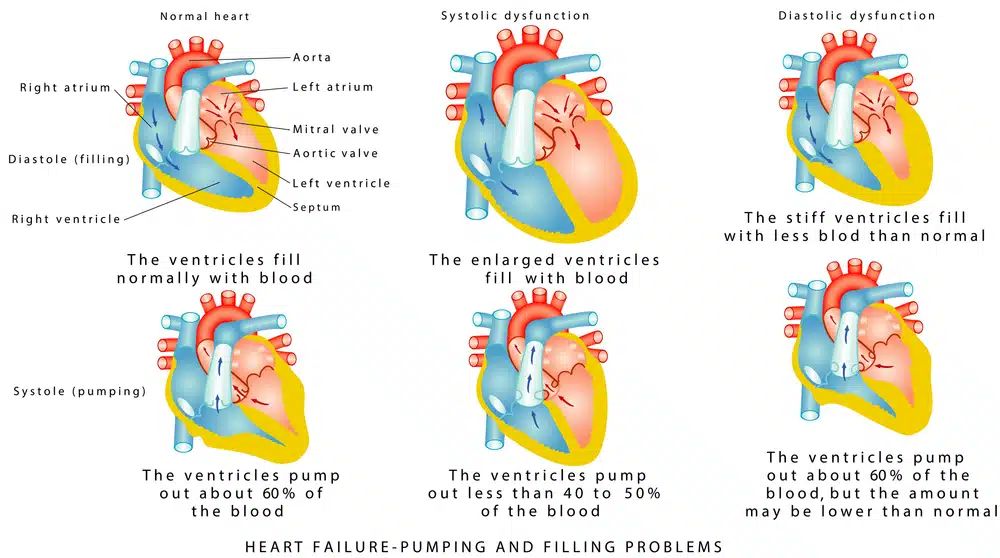
A heart attack (cardiac ischemia or myocardial infarction) can result in long-term damage to the area of the heart that did not receive appropriate oxygen and blood flow (via AHA).
The amount of damage depends on the size of the blood-deprived area and the duration of the deprivation.
Chronic Heart Failure is broken into four stages per the New York Heart Association.
- NYHA Classification - The Stages of Heart Failure:
- Class I - No symptoms and no limitation in ordinary physical activity, e.g. shortness of breath when walking, climbing stairs etc.
- Class II - Patients with cardiac disease resulting in slight limitation of physical activity. They are comfortable at rest. Ordinary physical activity results in fatigue, palpitation, or dyspnea.
- Class III - Patients with cardiac disease resulting in marked limitation of physical activity. They are comfortable at rest. Less than ordinary activity causes fatigue, palpitation, or dyspnea.
- Class IV - Patients with cardiac disease resulting in inability to carry on any physical activity without discomfort. Symptoms are present even at rest or minimal exertion. If any physical activity is undertaken, discomfort is increased (via Joint Commission).
Symptoms increase in severity according to the classifications.
Also read Heart Failure and Social Security Disability.
Symptoms & Treatment
Symptoms frequently described by clients from CAD are chest pain, shortness of breath, and unexplained fatigue.
Doctors usually test for coronary artery disease using an electrocardiogram (ECG), a coronary calcium scan, cardiac magnetic resonance imaging (MRI), a cardiac PET scan, catheterization (including angiograms), or a stress test (via the NIH).
Doctors often prescribe medications to help with Coronary artery disease and its symptoms. Anticoagulants, antiplatelet agents, ACE inhibitors, angiotension II receptor blockers, beta blockers, calcium channel blockers, cholesterol-lowering medications, diuretics, and vasodilators are all options (AHA).
If more aggressive treatment is needed, angioplasty with/without stent placement or bypass surgery may be done.
Coronary artery bypass surgery creates a new path for blood to flow around a blocked area. However, as an open-heart surgery, there are significant risks (Mayo Clinic).
Unfortunately, treatment in certain circumstances can further weaken the heart muscle and have long-term effects on the patient’s ability to work.
Coronary Artery Disease & Disability Benefits
You can be found disabled for Social Security Disability based on Coronary Heart Disease.
But as with all impairments with the Social Security Administration, the name of your medical condition is not as important as the severity of your symptoms.
The real question is whether your medical records demonstrate that your heart disease and accompanying symptoms (chest pain, shortness of breath, fatigue) are severe enough to prevent you from working.
The Social Security Administration can evaluate your claim for disability insurance under 4.04 Ischemic Heart Disease, on The Grids, or on the combination of your impairments.
Listing 4.04
This listing specifically addresses Coronary Artery Disease in part C:
4.04 Ischemic heart disease, with symptoms due to myocardial ischemia, as described in 4.00E3–4.00E7, while on a regimen of prescribed treatment (see 4.00B3 if there is no regimen of prescribed treatment), with one of the following:
C. Coronary artery disease, demonstrated by angiography (obtained independent of Social Security disability evaluation) or other appropriate medically acceptable imaging, and in the absence of a timely exercise tolerance test or a timely normal drug-induced stress test, an MC, preferably one experienced in the care of patients with cardiovascular disease, has concluded that performance of exercise tolerance testing would present a significant risk to the individual, with both 1 and 2:
1. Angiographic evidence showing:
a. 50 percent or more narrowing of a nonbypassed left main coronary artery; or
b. 70 percent or more narrowing of another nonbypassed coronary artery; or
c. 50 percent or more narrowing involving a long (greater than 1 cm) segment of a nonbypassed coronary artery; or
d. 50 percent or more narrowing of at least two nonbypassed coronary arteries; or
e. 70 percent or more narrowing of a bypass graft vessel; and
2. Resulting in very serious limitations in the ability to independently initiate, sustain, or complete activities of daily living.
You must have objective medical evidence (angiography or other testing) demonstrating that you have significant narrowing in your arteries or bypass graft vessel AND “very serious limitations in the ability to independently initiate, sustain, or complete activities of daily living.”
If you meet this listing, you are in bad shape. Many people receive stents or bypass before they meet this listing.
The surgery may reduce your narrowing to less than what is required by the listing, but you still may be unable to work due to your symptoms.
The Grids
The Medical Vocational Guidelines (The Grids) can help individuals over 50 years of age be approved for disability if they are restricted to sedentary work due to their impairment.
According to SSA, sedentary work involves lifting no more than 10 pounds at a time, occasional standing and walking (no more than 2 hours out of an 8-hour day), and frequent use of the hands (SSR 83-10).
If you are 50 years or older, with an unskilled or greater than sedentary work history, and your coronary artery disease prevents you from doing more than what is required at the sedentary level, you should be found disabled.
Those under 50 or the highly educated will find little help here.
Also read The Grids and Your Social Security Disability Case

Combination of Your Impairments
Coronary Artery Disease frequently co-occurs with heart failure, arrhythmias, and hypertension.
Often, with my clients, the combination of all their impairments, as well as the side effects from the medications that they take, is what eliminates their ability to engage in substantial gainful activity.
Social Security must consider the impact that all your impairments have on your ability to work, as demonstrated in your medical evidence.
If you are unable to work due to your Coronary Artery Disease, do not worry about meeting 4.04 or any other listing.
If your symptoms from your Coronary Artery Disease prevent you from working, file a claim for SSA Disability Insurance as soon as possible and call the Bishop Law Firm.
Delay may cause you to lose benefits!
North Carolina Social Security Disability Lawyer

Do you need a Social Security Disability Lawyer?
The Bishop Law Firm represents Social Security Disability clients in Raleigh, Durham, Fayetteville, Cary, Rocky Mount, Wilson, Smithfield, Louisburg, Chapel Hill, Roanoke Rapids, Winston Salem, Garner, Greensboro, Greenville, and surrounding areas in North Carolina.
Call us today for a free case review, (919) 615-3095, or start online now.