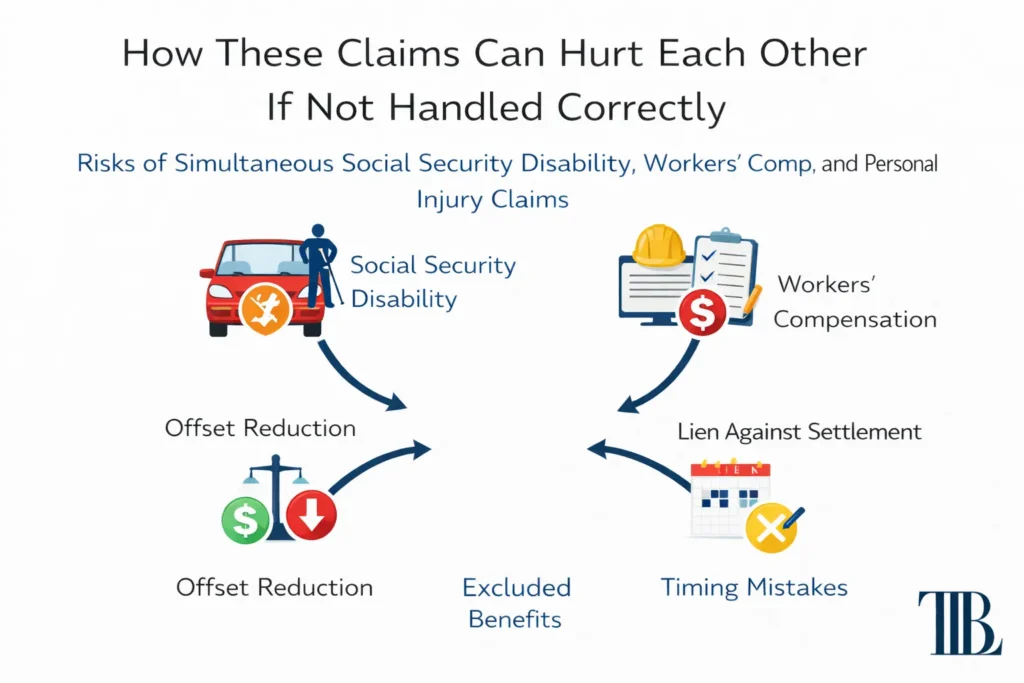
When an injury or disability involves more than one legal system, it is not enough to handle each claim separately. Decisions made in one case can directly affect the outcome of another—sometimes permanently.
If you have been seriously injured at work, are out of work due to disability, injured by a 3rd party while working, are already receiving disability, and are involved in a personal injury, you need a legal strategy that accounts for every source of compensation you are entitled to, that navigates the complexities of each without hindering your recovery for either.
The Bishop Law Firm represents Social Security Disability, Personal Injury, and Workers' Compensation clients in North Carolina. We do not get paid unless we win, and we offer free case reviews.

Social Security Disability, Workers’ Compensation, Personal Injury: what they have in common.
Although the laws governing these types of claims differ, with each having its own qualifying requirements, there are strong similarities among the three in how a victim can obtain recovery.
Coordinating legal work across all claims that a victim may have can reduce time to financial recovery and ease the frustrations that come with injuries and disabilities, in addition to having multiple lawyers for multiple cases.
Medical Records Acquisition
In all of the above, a victim's medical records are delivered to the decision-maker at different stages (to a DDS examiner, a personal injury insurance adjuster, a workers' compensation adjuster, an SSA Administrative Law Judge, an NCIC Deputy Commissioner, or a District/Superior Court Judge or jury).
All three claims require medical records to document the severity of the injury or disability. Gathering and analyzing medical records is one of the main jobs of a disability and injury lawyer.
In North Carolina, certain medical providers may require specific forms to obtain records. Knowing how to request records and the right records to request is fundamental.
Realizing when a victim needs to see a specialist for their symptoms, or knowing what the normal course of medical treatment is for a particular injury or ailment, can mean the difference between recovery and a failed claim.
An attorney who knows how to gather the right medical evidence is imperative.
Severe Disability and Injury Knowledge
Also, an experienced attorney who can review medical records and immediately recognize additional claims that need to be filed based on medical severity or fault is imperative.
Knowing the time limits for each type of claim, which type applies, and when to file it can ensure that a victim's full range of recovery options is available to them.
While some injuries are severe and acute, others will be chronic and necessitate the need for long-term or lifetime care.
An experienced attorney who has handled thousands of disability and injury claims can see impairments and their long-term consequences in a different light and know what the future holds for a victim.
Research and Investigation Needed
Research is key to successful disability and injury claims. While legal research is commonly thought of in the legal world, several other types of research are imperative to achieving the best outcomes.
When an insurance adjuster argues that an injury is not related to an accident, medical research can prove their theory wrong. In disability cases, it is not uncommon for those with rare diseases to have a hard time getting benefits. Educating judges on rare diseases can make a real difference.
Unfortunately, work injuries can be devastating. With a devastating injury with long-term repercussions, Fast Med is not going to cut it.
Knowing who a victim needs to see for medical treatment is required.
An investigation is required for all three case types. Knowing about a victim's daily life, an at-fault party's background, or an employer's previous OSHA violations can set a victim up for success.
An attorney who investigates and researches law and medical conditions is needed.
Reasons you need a lawyer who handles all three
How The Bishop Law Firm Coordinates These Claims as a System
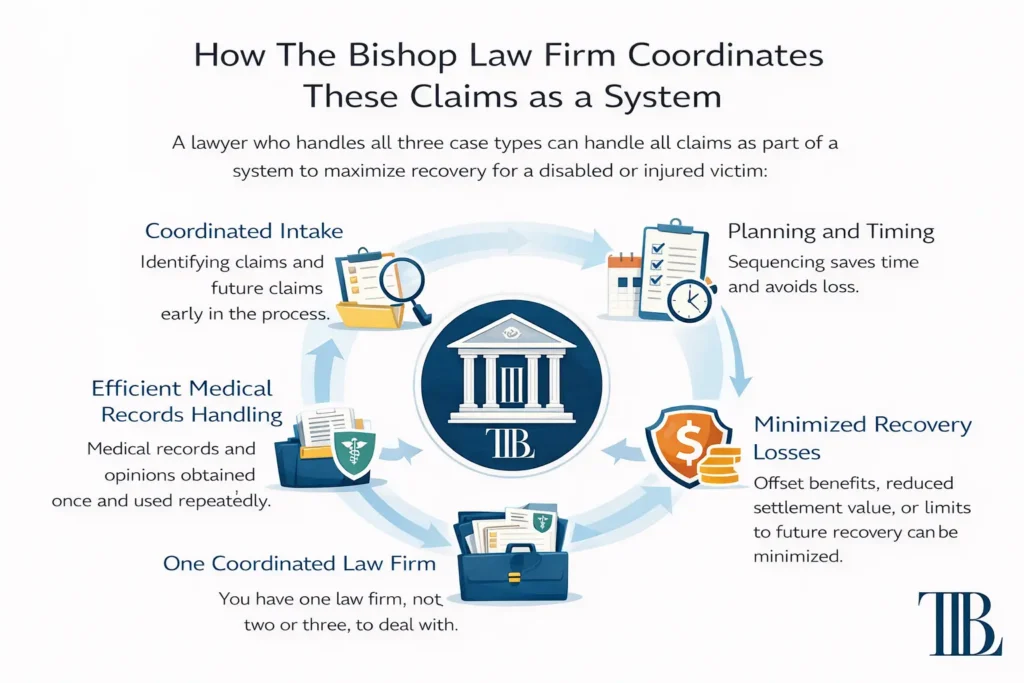
A lawyer who handles all three case types can handle all claims as part of a system to maximize recovery for a disabled or injured victim:
- Coordinated intake: identifying claims and future claims early in the process.
- Planning and Timing of all claims simultaneously - sequencing saves time and avoids loss.
- Offset benefits, reduced settlement value, or limits to future recovery can be minimized.
- You have one law firm, not two or three, to deal with.
- Medical records can be obtained once and used repeatedly, saving victims money.
- Medical opinions obtained in one case can be used in all cases.
What is Social Security Disability?
Social Security Disability is a federal program for disabled individuals. There are two main types of benefits: Social Security Disability Insurance Benefits (SSDI) and Supplemental Security Income (SSI). SSDI is based on the credits (FICA taxes) that you have paid from your work, while SSI is a need-based program based on financial need.
You must apply for benefits and be found disabled by the Social Security Administration before you are entitled to either benefit.
Read our Disability & Injury Law FAQs.
What is North Carolina Personal Injury?
Fault, and thus negligence, is imperative for North Carolina Personal Injury cases. If you are injured by someone else's negligence, you can recover the cost of your economic and non-economic damages under North Carolina common law.
After an injury, the injured party files a claim with the at-fault party's insurance company to seek damages. Damages a victim can recover include medical expenses, lost wages, pain & suffering, and punitive damages (in egregious cases).
If the insurance company refuses to pay or offers an unfair settlement, a victim will have to file a lawsuit in Superior or District Court in the county where the accident occurred to recover damages.
North Carolina Personal Injury Pitfalls
What is North Carolina Workers' Compensation?
North Carolina Workers' Compensation benefits were created by the North Carolina Workers' Compensation Act and are governed by the North Carolina Industrial Commission.
If a worker is injured at work (and no outside 3rd party is involved), fault is not a consideration. An employer and the injured employee must file forms with the North Carolina Industrial Commission regarding the accident, including whether the claim has been accepted or denied.
If there is a dispute between the employer's insurance and the employee, a hearing must be requested with the North Carolina Industrial Commission.
Social Security Disability, Workers’ Compensation, Personal Injury: pitfalls to avoid
SSA Disability and Personal Injury
Does a personal injury settlement affect disability benefits?
Personal Injury settlements generally have no financial ramifications for SSDI recipients, but because SSI is a need-based program, a personal injury settlement may offset SSI benefits if it exceeds the $2,000 countable resource (2026) limit. A special needs trust should be considered.
Example Scenario: A young man severely injured in a car accident with no real work history. He settles his personal injury claim for $75,000.00. Since he will be unable to work for the next year, he is applying for SSI through Social Security.
His application for SSI was rejected because of the $75,000.00 in his bank account. He will have to spend down his money to meet SSA's countable resource limits to be eligible to apply for SSI.
While personal injury settlements may not affect SSDI claims, timing is imperative. Applying for Social Security Disability as soon as you are unable to work can prevent an injury victim from losing out on disability benefits.
This can be a difficult choice, but Social Security Disability is payable if you have missed or will miss 12 months of work. After a severe injury, missing a year of work due to recovery can be a very real prospect.
Read about the difference between Supplemental Security Income and Social Security Disability.
SSA Disability and Workers Compensation
Can I get Social Security Disability and workers' comp at the same time?
Yes, but Social Security Disability benefits are offset by weekly workers' compensation checks. When workers' compensation cases are settled, and a clincher is agreed upon, an offset provision should be included to prorate the workers' settlement over their lifetimes rather than as a lump sum. This offset language prevents the offset.
Example Scenario: Client broke a leg at work. The client has several other medical conditions that affect his ability to work, besides his broken leg. The client receives weekly workers' compensation checks for his broken leg, and while he is out of work, his other health conditions deteriorate.
He applies for SSDI and is approved by Social Security. Since he is receiving a weekly workers' compensation check, his SSDI benefits will be offset by it.
Alternate Example Scenario: Assume the same individual above settles his workers' compensation case prior to applying for Social Security Disability. In the workers' compensation settlement (clincher) his attorney includes a offset provision that prorates the settlement funds over the rest of his life.
His SSDI benefits will not be offset.
Applying for Social Security Disability while on Workers' Compensation benefits can be tricky due to the offset and due to the fact that job searches may be required while you are drawing workers' compensation benefits.
NC Workers' Compensation and Social Security have very different definitions for disability. While NC Workers Comp is paying benefits, you should speak with an attorney to determine if filing for Social Security Disability is the right move or if waiting until you settle your workers' compensation case would be more financially beneficial.
Read about how NC Workers' Compensation and Social Security Disability interact.
NC Personal Injury and Worker Compensation
Can I have workers' comp and personal injury claim together in NC?
If you are injured at work by a 3rd party, you can have a workers' compensation claim and a personal injury claim from the same accident (think you are involved in a car accident while working). These cases can bolster one another, but the settlements in each case must be timed correctly.
It should be noted that in these cases, workers' compensation insurance carriers frequently place a lien on the personal injury funds. The reason for this is that a 3rd party caused the accident, and thus a 3rd party should pay for the accident.
Because of this, a workers' compensation case should usually settle first.
Caution should be exercised when signing releases for either case. A victim must ensure that anything they sign does not relieve a 3rd party of liability.
NC Workers' Compensation vs. Personal Injury
Social Security Disability + Workers’ Compensation + Personal Injury
If a victim is injured in a catastrophic injury case at work by a third party, one injury can create three separate legal matters.
In addition to the above considerations, this type of injury would require a legal plan that covers all three areas and helps ensure that the victim and their family are cared for today and tomorrow.
Do you need a lawyer who handles Social Security Disability, Workers’ Compensation, and Personal Injury?
If you have been seriously injured at work, you may need help with workers' compensation and Social Security Disability. If you have been injured by a 3rd party at work, you may need help with all three practice areas.
If you are already on disability benefits and are injured by a 3rd party, an attorney can assist you with avoiding potential offsets to disability benefits from a personal injury settlement.
Without coordination of claims, a victim may wait too long to apply for Social Security Disability, miss the statute of limitations in a personal injury case, or fail to file a Form 18 with the North Carolina Industrial Commission, thereby barring recovery on valuable claims.
Coordinating benefits from the first call to a firm can improve financial recovery, eliminate stress, and ensure that a victim receives all compensation to which they are entitled under the law.