If you have sustained a leg injury after a car accident, read about common leg injuries and some tips about your personal injury compensation.
The Bishop Law Firm offers free case reviews for North Carolina car accident victims. Call us today at 919-615-3095 for your free case review or start online now.

How Much Is a Car-Accident Leg-Injury Claim Worth?
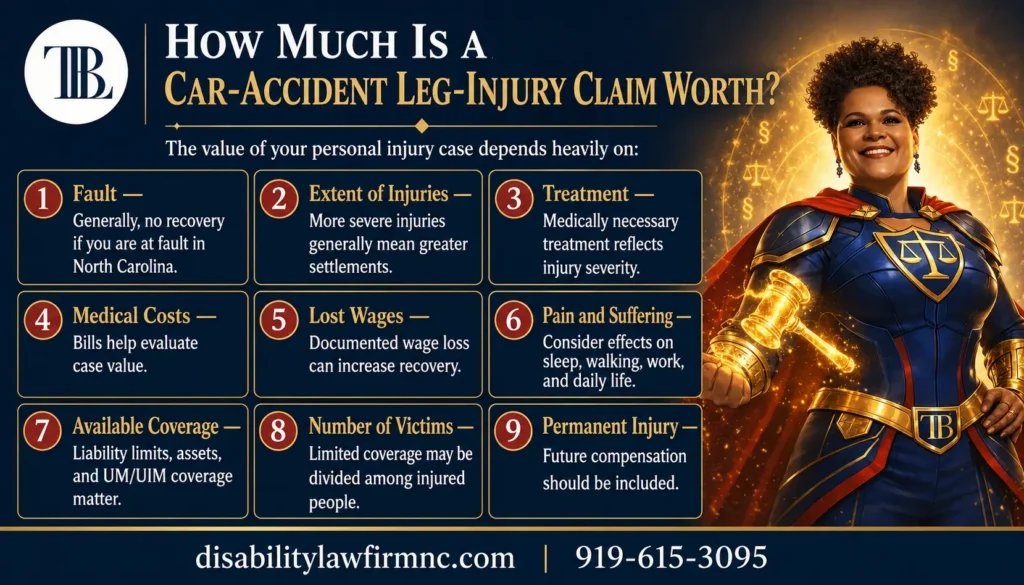
The value of your personal injury case depends heavily on the following:
- Fault - if you are at-fault for your injuries, you generally can not recover compensation in North Carolina.
- Extent of your injuries - generally, more severe injuries mean greater settlement amounts.
- Types of treatment you receive for your injury: medically necessary treatment reflects injury severity.
- Cost of said medical treatment. While medical bill amounts alone do not always determine case value, they give most insurance adjusters and personal injury attorneys a place to start when determining value.
- Documented lost wages - it naturally follows that the greater the wage loss, the greater the recovery.
- Impact the accident has on your daily life (pain and suffering) - a daily inconvenience will not compare with an injury that causes your life to grind to a complete stop. If you can not sleep, walk, brush your teeth, cook, etc due to pain, your life has been severely altered.
- The at-fault party's insurance limits and assets, as well as your UM/UIM policy limits, matter.
- Whether there were several victims or simply one: more victims mean that the limited recovery has to be split between multiple parties.
- Permanent injury compensation should be included in any settlement.
Example Car Accident Leg Injury Settlements
$125,000 Policy-Limits Settlement Following Drunk-Driving Collision
The client sustained a foot fracture in a collision caused by an impaired driver.
The Bishop Law Firm filed a personal injury lawsuit. The case settled before trial for the available $125,000 liability policy limits. No additional underinsured-motorist coverage was available.
Read more about accidents caused by drunk drivers.
$100,000 Policy-Limits Settlement After Head-On Collision
The client sustained a serious knee injury in a head-on collision after another driver crossed into oncoming traffic. The injury required surgery.
The claim settled without litigation for the at-fault driver’s available $100,000 liability policy limits.
Read more about North Carolina car-accident injury claims.
$50,000 Policy-Limits Settlement for Injured Pedestrian
The client sustained multiple fractures after being struck by a vehicle while walking.
The claim settled without litigation for the at-fault driver’s available $50,000 liability policy limits. No additional automobile insurance coverage was available.
These prior results do not guarantee a similar outcome in another case.
Read why policy limits matter in a North Carolina personal injury case.
Common Leg Injuries from Car Accidents
Why does my leg hurt after a car accident?
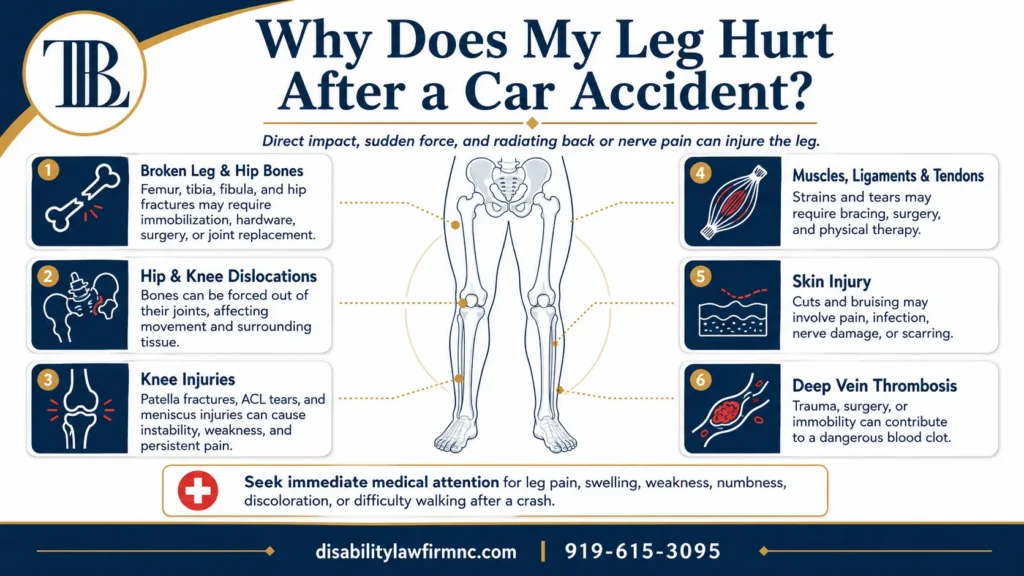
In a car accident, an injury to the leg can range from a minor skin abrasion to injuries that require total joint replacement.
Direct hits to the leg from internal car components, sudden jolts from impact, and back and nerve pain that radiates can all cause leg pain after an accident.
If you are having leg pain after a car accident, seek immediate medical attention.
Broken Leg and Hip Bones
Broken Leg Bones - The legs contain the longest bones in the human body: femur, tibia, and fibula. Bones can snap into two clean pieces or shatter completely (comminuted). The bone may or may not stick out of the skin (open). The more complicated the leg fracture, the longer it will take to heal. Crush injuries are among the worst bone fractures. A broken femur means the loss of stability from the largest and strongest bone in the body.
X-rays are usually used to diagnose a broken bone, but stress fractures are more difficult to diagnose (Via WebMD). Treatment begins the same as discussed below for dislocation; then a splint, pins, wires, or rods, and a cast are used to keep the bones still while they heal. At a minimum, you will need 6-8 weeks to heal.
Broken Hip Bones - Hip fractures occur at the upper end of the femur. In my practice, hip and femur fractures seem to be the worst and most troublesome. The pelvis plays a major role in your body's balance and movement. Once damaged, the body takes substantial time to heal. Depending on the type of break, surgery can involve screws, plates, and even total hip replacement (Via OrthoInfo).
Also see Foot Injury After a Car Accident.
Dislocated Hips and Leg Bones
Dislocation happens when a bone comes out of its joint. The damage or deformity may or may not be visibly apparent, but the intense pain and inability to move are undeniable. Leg injuries from car accidents are the most common cause of hip dislocations. The knee can dislocate when the femur and tibia (shin bone) no longer meet at the knee joint
An X-ray and MRI are usually given to determine the extent of the bone dislocation and the damage to the surrounding soft tissue. Reduction, immobilization, surgery, and rehabilitation are treatment options an orthopedist may recommend (via Cleveland Clinic).
Knee Injuries
Knee Injury - A kneecap (patella) can be broken or dislocated. Patellar fractures are common in a head-on collision. Immobilization may work to heal the fracture, but if your patella is shattered, surgery will be needed.
Unfortunately, post-traumatic arthritis, weakness, and chronic pain are long-term possibilities (Via OrthoInfo).
Also, an anterior cruciate ligament (ACL) injury or torn meniscus can lead to knee instability, inability to move your knee normally, or persistent knee pain (Via Mayo Clinic).
Muscles, Ligaments or Tendon Strains and Tears
Muscle, Ligament, or tendon strains or tears can cause leg pain, swelling, and even an inability to use the muscle. Usually, a doctor's physical examination is enough to diagnose a muscle strain or tear.
You may need crutches or braces to immobilize the area and give it time to heal. If the tear is complete or substantial, you may need surgery and physical therapy.
Skin Injury
A skin injury can be shallow or deep enough to reach the bone. If the cut is to the bone, the leg injury will take longer to heal.
Depending on where the laceration is, it may cause severe pain and affect your ability to walk, sit, and stand. Sutures may be required, and nerve damage is possible. Inflammation, infection, and scarring are always possible. Proper wound care is imperative.
Bruising is a common injury among car accident victims. However, seek medical treatment to confirm the bruise is superficial and not a more serious injury (see the discussion on Deep Vein Thrombosis below).
For more, read our article: Skin Injury After A Car Accident.
Deep Vein Thrombosis
Deep Vein Thrombosis - in simple terms, a blood clot that is located deep in your body. Injury from trauma to your leg during an accident or the surgery required to repair your injuries may both cause damage to your blood vessels. Pulmonary embolisms are a complication of a DVT. If you have unexplained pain, swelling, or discoloration, you should seek medical attention (Via HealthLine).
North Carolina Car Accident Laws
If you have car accident leg injuries, you may be able to recover your losses in North Carolina from the at-fault party's insurance company if the car accident was not your fault.
Negligence
How is fault determined in a car accident in North Carolina? After a car wreck, the police officer will usually cite the at-fault party and put a description of the accident on the bottom of the 2nd page of the accident report. If law enforcement does not cite the at-fault party, the description of the incident can be used to determine fault.
But without a clear description of events, the insurance adjuster may deny that their insured is at fault or allege that the victim is contributorily negligent.
Contributory Negligence
North Carolina is one of the four remaining contributory negligence states (Alabama, Maryland, and Virginia). This means the victim must not be at fault to recover for their car accident injuries.
Contributory negligence often results in unfair outcomes for victims but is the law in our state. One exception to contributory negligence is the "last clear chance doctrine". The last clear chance doctrine can help victims if the at-fault party had the last opportunity to change course and avoid the injury. This very rarely helps a victim.
Damages Available
If you have been injured in a car accident through no fault of your own, you can recover the costs of your missed time from work, medical expenses, and be compensated for your pain and suffering. If warranted, include future medical bills and lost wages.
Punitive damages can also be awarded to punish the at-fault party for egregiously wrongful acts (rare). Drunk drivers who harm others while behind the wheel may be liable for punitive damages. However, simply causing an accident due to distracted driving may not rise to the level of "egregiously wrongful."
Statute of Limitations
How long after a car accident can you sue in North Carolina?
NC has a three-year statute of limitations from the date of injury. If your loved one was killed in the car accident, you have two years from the date of death to bring suit.
If you were injured while at work in a motor vehicle accident, you could have an NC Workers' Compensation case as well as a car accident claim.
What about car accidents involving self-driving cars or sudden emergencies?
Tips For Your Personal Injury Case
- Take photos of the accident scene and your leg injury when it first happens and as you heal. Photographs are the best way to show how harrowing this injury has been for you.
- Seek medical treatment as soon as possible after the accident and inform them of how your injury occurred.
- Follow all medical advice.
- Report your injury to your employer so they can document your lost wages due to the car accident.
- Avoid social media or any activity that can be construed negatively by the driver's insurance company.
- Keep a list of all your medical treatment for the injury, your missed time from work, and a daily log of how the injury has affected your life.
- You can file a claim with the at-fault party's insurance company, or you can hire an attorney to help you even before you file the claim.
- If you file a personal injury claim with the insurance company, insurance adjusters can request that you do a recorded statement. The question of whether you should make a recorded statement, or how much discussion you should have with the adjuster, is best discussed with your car accident lawyer.
If you have sustained leg injuries after a collision, you may be facing substantial medical expenses, lost wages, as well as pain and suffering. The insurance company is not required to inform you of all compensation you are entitled to, nor will they. Having a North Carolina Car Accident Lawyer on your side ensures that you have someone on your side.
Call us today for a free case review at (919) 615-3095 or start your free case review now. The Bishop Law Firm represents car accident victims in
- Raleigh
- Cary
- Durham
- Rocky Mount
- Wilson
- Fayetteville
- Smithfield
- Louisburg
- Chapel Hill
- Roanoke Rapids
- Apex
- Greensboro
- Winston-Salem
- Greenville
- and more!
We look forward to working with you and wish you a speedy recovery!
Also read: North Carolina Car Accident Lawyer.