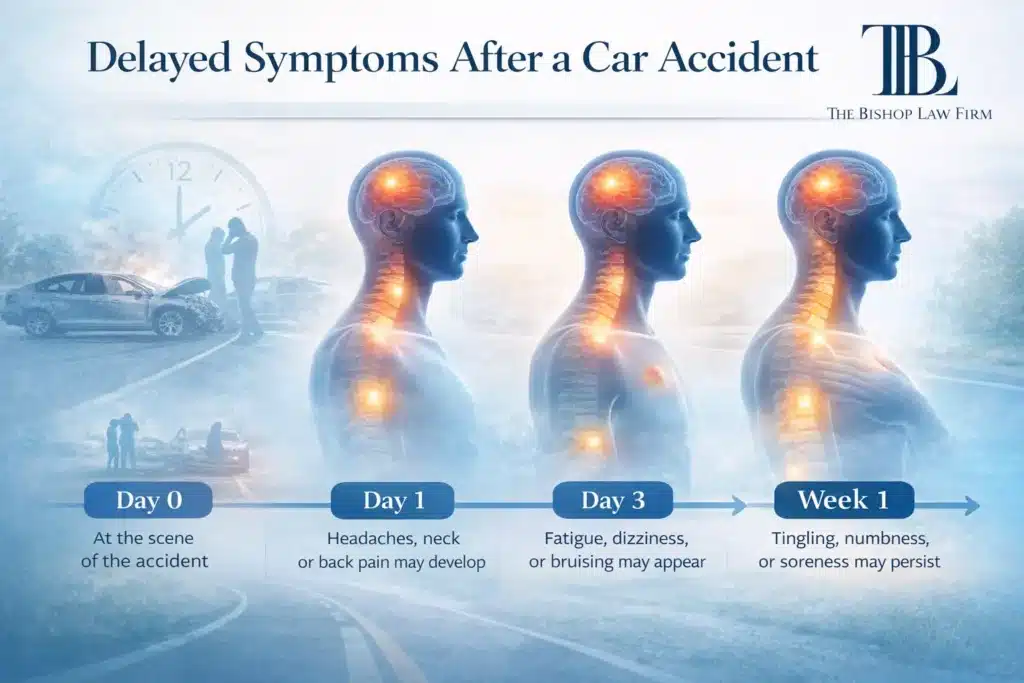
Immediately after an accident, you may have apparent injuries, but what happens if you begin to experience delayed symptoms in new areas of your body?
After an accident, it is normal for adrenaline and shock to mask pain. For many people, pain starts when the fight or flight response subsides.
If you have been injured in a car accident or begin to develop symptoms later on, please seek immediate medical attention. Below are some common delayed symptoms from car accidents.
Common Delayed Symptoms After a Car Accident
Unfortunately, once over the shock of an accident, awareness of injuries increases, leaving a victim wondering about the seriousness of their injuries.
We advise our clients to seek medical attention as soon as possible after a car accident, and to do so again if new symptoms arise or existing symptoms worsen.
It should be noted that the longer you wait to receive medical treatment after your accident, the more difficult it will be to prove that your injuries arose from the accident.
Headaches
Headaches can be a symptom of whiplash that can occur up to 24 hours after your accident. Whiplash headaches most often start at the base of the skull.
A traumatic brain injury could also be the cause of your headache. You do not have to sustain an injury to the outside of your skull to have a traumatic brain injury.
A sudden jar can cause your brain to shift inside your skull and damage tissue, as in the case of a concussion, diffuse axonal, or contrecoup brain injury.
Worsening headaches, confusion, or dizziness need medical attention.
Chest Pain
Seat belts and airbags, while designed to protect us during an accident, can actually cause chest bruising if we are involved in an accident.
This chest bruising can be superficial, cause broken ribs, or even a cardiac contusion.
Costochondritis (chest wall pain) can feel like a heart attack, but it is really just inflammation of the cartilage that connects a rib to the breastbone.
Shortness of Breath
Shortness of breath can be caused by a lung contusion from an accident. While you may have bruising on the outside of your body, you may also have internal bruising of an organ as well.
If you imagine what a bruise looks like on the outside of your body, you can see why a lung contusion causes shortness of breath.
At the contusion site, blood accumulates and interferes with the lung's ability to supply your body with oxygen.
In addition to a lung contusion, broken ribs can make breathing especially difficult.
Bruising & Swelling
Most bruises will look worse in the days following an accident, but eventually resolve on their own. Swelling can occur from trauma or blockage.
Unfortunately, DVTs (deep vein thrombosis) can arise from an injury. DVTs are clots of blood in deep tissue (usually the legs) that are usually not noticeable from the skin's surface.
Bruises should be examined to determine if they are superficial or deeper.
Pain and/or Numbness
Symptoms of pain and/or numbness are signs that something is wrong. Pain can be mild to severe depending on the impact of your injury.
If pain develops after your accident, you should seek medical treatment as soon as possible.
Numbness can be caused by radiculopathy (nerve damage). A sudden jar during an accident may cause a shift in your spine, which may result in the compression of a nerve.
Numbness is definitely a symptom that you should not ignore.
Anxiety
Unfortunately, a car accident can leave us with more than physical injuries. After a car accident, you or a loved one can develop anxiety or fear about driving or riding in a car. Acute Stress Disorder, PTSD, and Vehophobia are all possibilities.
If you begin to experience these symptoms, seek mental health treatment.
Delayed Symptoms Should Not Be Ignored
If you develop delayed symptoms after a car accident, you should seek medical attention as soon as possible.
While the cost of medical treatment is not negligible, the cost of not seeking treatment when needed can be very high and detrimental in the long term.
Related Injuries After a Car Accident
You may also want to learn more about specific injuries that can develop after an accident:
- Brain Injury After a Car Accident
- Neck Injury After a Car Accident
- Back Injury After a Car Accident
- Blunt Force Trauma to the Head
- Chronic Conditions From Car Accidents

Also read North Carolina Car Accident Lawyer